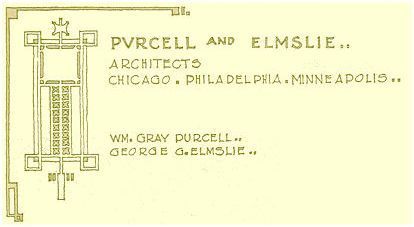
 |
firm active: 1907-1921 minneapolis, minnesota :: chicago, illinois |
 Navigation ::
Home :: Bibliography
Navigation ::
Home :: Bibliography
"Purcell and Elmslie, Architects"
This essay was the first monograph published on the work of Purcell and Elmslie. A version appeared in "Art and Life on the Upper Mississippi, 1890-1915: Minnesota 1900," edited by Michael Conforti and published by University of Delaware Press in 1994. No gallery was presented to me for proofing, which resulted in some omissions of detail and typographical errors. For the moment, here the text is in one stretch, albeit with dysfunctional footnote links. You can find the footnotes properly numbered at the bottom of the page. The Microsoft Word conversion into HTML is much like that old Scottish proverb: "The more you overtink the plumbing, the easier it is to stop up the drain." Purcell & Elmslie, Architects: The Design of Destiny
by Mark Hammons
Web Version ©Mark Hammons 2003George Grant Elmslie (1869-1952) and William Gray Purcell (1880-1965) were two men born to a challenge. Both became architects committed to the quest begun one hundred years ago to establish an indigenous American architecture. One came to America an immigrant from the heaths of Scotland, the other was a son from the third generation of a pioneering American family in the Midwestern prairie. [1] Brought together in partnership, their common goal was the application of a spiritual truth to the making of buildings and all the other objects of life. To Purcell and Elmslie, this was the noblest of causes.
Their undertaking was inspired by pride and insight into the vitality of the time and place where they lived. Unprecedented cultural achievements were emerging from a political democracy nourished by the ideal of individual freedom. The economic wealth and technological power produced in this new world surpassed all historical antecedents. The social authorities controlling these forces, however, preferred to render architectural forms in images of the past. Regardless of modern purpose, buildings were draped with revisions or outright copies of ancient Greek and Roman, medieval Romanesque and Gothic, English Tudor, Italian and French Renaissance, Oriental, and even Egyptian designs. To architects like Purcell and Elmslie, such revivalism was a dishonorable betrayal of American accomplishments.
Architects who wanted their designs to express the unique depth and strength of American life in their designs charged there was a basic perceptual error in the revivalist perspective. People were romantically attracted to historical architectural forms, they said, because in the original buildings there was an intangible lasting presence that spoke of the survival of human values. The awareness existed that the survival of antique architecture was emblematic of human identity and, hence, endurance. Reproduction of the historical images in modern structures was an attempt to claim those qualities in the present. In actuality, however, only the external shape was exhumed from the past. The connection between the appearance of an ancient building and the construction techniques that had been used to make the structure was disregarded. For those who despised revivalism, this break in functional continuity was literally the difference between life and death. The definition of beauty was the pivot of their argument.
To revivalists, beauty was a discretely identifiable element whose presence in architecture could be calculated and installed readymade. The justification of this view was rooted in the tenets of scientific reductionism, the dominant philosophical orientation of the day. Adherents of this approach declared that architectural beauty had already been invented and brought to perfection in ages past. They projected their own sense of rationalism into the minds of earlier architects whose designs were then dismembered to sort out a palette of isolated decorative elements which could be attached piecemeal to new buildings. All the modern practitioner had to do was apply a scale ruler and total the various segments, like an arithmetical sum, then size the historical appearance accordingly. Indeed, the thought of doing more could be considered presumptuous in the face of historic architectural attainments. This method claimed kinship with those of the flourishing physical sciences, which assumed the eventual elimination of all impediments to the triumph of man over nature. Beautiful architecture, revivalist architects declared, depended on how well the given recipe was followed.
Other architects, distinctly a minority in the profession, held an antithetical perspective. They believed that the beauty perceived in the visible forms of historical architecture was not a cause but an effect. To them the true beauty of a structure was the result of clearly understanding and directly expressing the present moment in human life. Buildings were to be seen as an outward growth of cultural abilities and aspirations. The man who heralded the argument was a Chicago architect named Louis Henri Sullivan (1856-1924). Fierce and soulful in his message, Sullivan asserted in both his work and his words that architectural forms were purely reflections of the inner nature of the builders. The truth of architecture was not in the image, but in the event. Spiritual honesty, he emphasized, required architectural honesty. The ghostly recreations of historical revivalism were blasphemy.
The creed advanced by Louis Sullivan conceived of architectural design in the biological metaphor of the natural world. In that sphere, of which humans were inextricably part, all experiences came into being through the actions, or functions, that were transmitted by the structural shapes, or forms, of material objects. All physical things conducted directly a momentum of activity, like copper wire carried electricity. One event arose from another in a cascade of interrelationship. This holistic mode of enfoldment was the fundamental order of existence, the way everything worked. Sullivan epitomized his view in the phrase form follows function.
The organic architectural philosophy initiated by Louis Sullivan descended from his own practice principally through two lines. One of these paths encompassed the much-examined work of Frank Lloyd Wright (1867-1959), whose lengthy and metamorphic career has continued to attract a large public following. The other direct lineage from Sullivan was formed by the partnership of George Grant Elmslie and William Gray Purcell. Because their work is rarer and not as publicly identified, the labors of Purcell and Elmslie for the cause of organic architecture have been less celebrated than those of Wright. Nonetheless, their understanding and articulation of organic design was fully developed on the most profound and encompassing levels:
These organic procedures exemplified the living relation which was practiced in exposition of democracy within our living world. Architecture as we saw it was called upon to express, in peace and mutual respect, that cooperation between the inanimate ‑ the material world, which we now know is never inanimate or "material" ‑ and the world of Man, together with his companions, the animals and the plants.... If these relations within a living democracy cannot be shown as the home and fountain of our mutual life in common with all living creations, then any further attempt to study and explain them becomes futile. [2]
For Purcell and Elmslie, organic architecture was a matter of faith. Any assessment of their work must take into account the metaphysical motivations implicit in the work of these architects. Their spirituality, however, needs to be severed from the dogmatic connotations of religion. The key to the spiritual concept realized by the organic architects was a kind of gnostic perception, through which the continuities of past and future human life were identified contextually with the immediate circumstance. Inner recognition of need and response came first, and the external formulation of shape derived from those informing ideas. If done with spiritual conscience, organization of the mundane elements would intuitively endow the structure with the intangible yearnings out of which the design had first commenced. By the organic standard, this task was the vocation of the architect. Those devoted to this cause envisioned the result to be an important means of social progress, and thus came to be known in general parlance as progressive architects (a usage of the term distinct from, though obviously in character with, the contemporary political drive of the same name). Because this movement was born and centralized in the prairies of the American Midwestern states, these men and women have also come to be called Prairie architects. [3]
One of the prime influences shaping the American architectural environment at the turn of the century, especially visible in the designs of Purcell and Elmslie, was the increasing integration of machinery into ordinary life. The twentieth century arrived in a rush of acceleration. The unprecedented liberty of personal movement provided earlier by trains and steamships was being augmented by automobiles and airplanes. Audio recordings, motion pictures, telephones and other innovations quickened individual intellect and desire. Fascination with the rising tide of machinery was a powerful, even overwhelming social force that is now very difficult to appreciate completely. In architectural terms, mechanical household conveniences did not need the living spaces required for human servants. Therefore, architects could contract domestic architectural forms, omitting entire floors of live-in staff quarters while at the same time the new devices were absorbed into the very fabric of the house. These kinds of changes were seen widely as a liberating conquest. There was an optimism, a nearly unshakeable shared belief in the ability of machines to improve almost infinitely the human lot.
A social pressure existed for an aesthetic as well as structural response that organized and clarified the extraordinary pace of change. A variety of approaches emerged in response. Revivalist architects did incorporate modern improvements such as fireproofing and bathrooms into their designs, though these functions were by and large still hidden within historicist wrappings. Others wanted a more visible mechanical expression, but disagreed aesthetically over the rendition. Designs by Purcell and Elmslie, for example, are often mistakenly grouped with those of the American Arts and Crafts movement. Although the American cousin of the original English Arts and Crafts movement partook more liberally of a working relationship with machines, the fundamental orientation of the Arts and Crafts followers was usually toward the handicraft production values of the past. Mechanical expediency was secondary to the achievement of an aesthetic value of hand process. While some of these craft-oriented elements were used successfully by Purcell and Elmslie in their designs, often at the behest of clients, the fundamental philosophical motivation of the firm was outside the objectives declared by the framers of the Arts and Crafts movement. By their own estimation, the revelation of the machine element in the work of Purcell and Elmslie went beyond what they regarded as a retrograde, if publicly popular, limitation. [4]
Some insight into how deeply consciousness of the machine penetrated the work of Purcell and Elmslie and the strong interrelationship with Sullivan's thesis of natural poetic expression can be seen in a short volume by Gerald Stanley Lee titled The Voice of the Machines. [5] George Elmslie recommended the book enthusiastically to Purcell, who found an epiphany. The the author argued that the modern relationship between man and machines, and by extension machines to architecture, was poetry in a threefold way. First, there was the human motivation to honest labor, like the organic architects to their profession. "Every man who loves his work, who gets his work and his ideal connected, who makes his work speak out of the heart of him, is a poet." [6] Second, machines themselves were the poetry of the age, a pattern of modern needs and wants upon the weave of time that could not have been understood by people of a century--perhaps half a century--earlier. Third and most encompassing, the absorption of machinery into life was not an eclectic collection of mechanical fragments. Instead, life had been cast organically in the mold of iron, coal, and electricity. Just as surely as humankind lived within the body of flesh and blood provided by nature, so did the race now exist as fully and completely through an entelechy of machines. [7]
These underlying historical conditions laid the foundations for a dramatic philosophical response from Purcell and Elmslie. Among the most sensitive and articulate of the progressives, every significant example of their work was at heart the expression of their concept of a higher truth. They understood the rendering of design as the defining act of personal and communal self-identification, a palpable metaphysical creation that first entered into physical existence on the surface of the drafting board. Purcell recorded how this was clear when watching Sullivan in his office:
Sullivan in action built a sort of fourth dimensional motion trace, for Sullivan's architectural concept was never a 'plan and elevation' sequence. His organizing and articulating development moved from origin to fulfillment in three dimensions. The germinal thought expanded concurrently in all dimensions, acknowledging relativity as it moved to its destiny...Life itself was flowing through his mind...as if his hands...were recording a general philosophical structure in space, of which the plane of the paper cut through a completely realized geometric concept. [8]
The discovery of this profundity, of course, did not take place in an intellectual vacuum. The kind of conceptualization Purcell witnessed with Sullivan was part of a broad change in human consciousness still today incomplete: the practical understanding of time as a fourth dimension of being inherent in all things. In the early 1900s, mathematicians Albert Einstein (1879-1955) and Hermann Minkowski (1864-1909) rejected the absolute individual existences of space and time. Instead, they replaced those two separate abstractions with one scheme of a four-dimensional continuum. The basic premise of these new theories bonded all objects that humans could sense as three-dimensional--including themselves--within a higher reality whose essential characteristic was defined by relative movement. As Sullivan suggested in his own way, a thing became what it was only by relationship to a universal field of change.
Learning to perceive the world in terms of four dimensions was the most challenging mental puzzle of the time. Magazines like Scientific American sponsored contests to find explanations easily understood by the popular audience. The problem was that fourth dimensional consciousness could not be experienced through the physical senses. Only the mind was capable of opening a frame of reference into this new realm of comprehension. Among those bringing logic and projective geometry to bear on the task was a New York architect named Claude Bragdon (1866-1946). In an essay titled "Space and Hyperspace," he taught readers how to draw their own portals into the fourth dimension called tesseracts. [9] The resulting graphic device was the fourth dimensional analog of a cube. Seen in the two dimensional perspective of a line drawing, there were four squares set equidistantly to one another. This implied a fifth yet invisible square, whose interior was implied by a cross of open space between the original four visible squares. The image represented a shift from external to internal perceptions of reality. Bragdon called this a "higher level," explaining that the relationship of a higher space to a lower one is always an inner state of recognition. [10]
To Purcell and Elmslie, the conceptual mechanics involved in this symbol described perfectly the process of unfolding organic design. Whether drawn outright or indicated typographically by a pair of joined colons, the device appeared on their presentation drawings, correspondence, advertising brochures, and in the issues of an architectural journal, The Western Architect, which they designed to illustrate their work. The tesseract was the summa for all the geometric forms that played within their decorative designs, signifying the substrate of divine creative process from which material objects crystallized into being. This illustration declared that the physical, emotional, mental, and spiritual elements of human consciousness interpenetrated simultaneously in one and the same moment of creation.
To make these interrelationships even clearer, Bragdon worked to develop a theory of projective geometry to serve as the basis for architectural design. He realized, however, that these treatises were almost as inaccessible to the vast majority of people as were as the elaborate formal proofs of Einstein. If there was going to be a wider breakthrough in public consciousness, written language would have to be the vehicle. His task took an unexpected but perfected suited turn when he joined in the translation of a book and many essays by the Russian author P. D. Ouspensky, whose principal ouevre was titled Tertium Organum. The text examined the rationalization of empirical experience from the observational deductions of the early Greeks through the experimental scientific methods of the industrial age, then asserted that fourth dimensional awareness was the third organon, the next step in the evolution of human understanding. Ouspensky concluded his book with logical and philosophical arguments that all natural events took place within a single vast universal organism. The mystery of this "cosmic consciousness" became comprehensible only when the perspective of isolated objects was abandoned. [11] In the writings of Bragdon and Ouspensky, Purcell and Elmslie recognized a description of the same metaphysical unity posited by Louis Sullivan. [12]
Psychologists such as William James (1842-1910) and Carl Jung (1875-1961) sought to identify the workings of this truth in the shadow play of human consciousness. They discovered, not coincidentally, this consciousness newly recognized in the West was an ancient realization in the religious and philosophical systems of the Far East. The majority of progressive architects were highly educated people who read widely in literature, followed developments in theoretical science, and were open to a variety of spiritual perspectives. They were aware of the studies of Emerson and Thoreau, for example, in Vedic scripture and the mythology of the Indian subcontinent. [13] Their affinity for the transcendentalists has long been a matter of record. Elmslie and Purcell, for example, often cited Walt Whitman and Edward Carpenter as philosopher poets of the organic movement. The Theosophical enterprise started by H. P. Blavatsky (1831-1891) and the descendant Anthroposophy of Rudolph Steiner (1861-1925) attracted some of them, notably Walter Burley Griffin (1876-1936) and his wife Marion Mahoney (1871-1962). A few of the progressives also found a kinship with some of the mind control philosophies of the time, as Purcell and Walter Burley Griffin did through Christian Science. [14]
The practices in which these spiritual investigations were finally expressed varied with the individuals, but there was a surprising and ironic source that served in common as a kind of aesthetic catalyst. If there is a single external awareness useful in penetrating the gnostic depth of understanding in organic design, that crucial element can be found in the presence of Oriental, especially Japanese, art forms. The popularity of Japanese prints in Europe and the United States during the period, for instance, is a widely documented fact. Credit for the importance of their aesthetic values to the outcome of progressive architecture was indicated by no less a figure than Frank Lloyd Wright, who said he was uncertain what would have become of his designs had he not encountered the graphic forms called ukiyo-e, specifically those by Hiroshige (1797-1858). Indeed, Wright was not above noting himself in virtual collaboration with his favorite nineteenth-century artist. [15]
While the Prairie architects did have a strong appreciation for Asian artistic accomplishment, they obviously wanted to copy that work no more than they did a European precedent. What attracted them so strongly was much deeper. In terms of their own experience, the culture in which they worked was being forced by geographical limitation, aesthetic quandary, and industrialization to shift into an introspective character. There was a duality to this predicament anchored in the same philosophical conflict that rose so close to the surface
in organic arguments against architectural revivalism. In the fluid dynamic between contemplation and event at the heart of Japanese ukiyo-e and other forms of Oriental artwork, many organic architects, artists, designers, writers and others concerned intuitively perceived the true nature of their adversary at home. [16]
The basic assumption behind the reductionist mentality was that human perception and experience functioned independently from the framework of the natural world. Louis Sullivan proclaimed with utmost conviction the message that all true art and architecture was a poetic expression of human passages through a wholly enfolding, inescapable spiritual continuum. Unfortunately, his lyric was often abstruse. Part of the problem was that the linear structure of a Western language like English did not well suit the kinds of manifold meaning needed to reveal the profounder implications of progressive observations. Rather, the organic purport would have been more clearly transmissible in an ideographic system like Chinese or Japanese. In effect, this is the role that fell to art forms like Japanese prints, which graphically delineated the same kind of holistic sensibility that burned inside of the organic architects. Even though the Oriental and American visions were separate in time and place, the function of human existence within, instead of outside, the processes of nature was transcendentally perceptible in both. The message of inescapable interrelationship that lay at the heart of the most powerful modern scientific insights, from Einstein's theory of relativity to the psychological writings of William James, directly contradicted the view of the scientific reductionist approach. Whether or not this realization rose to full consciousness in the work of any given progressive architect--clearly some made the intellectual connection--the work of the Prairie architects benefited. William Gray Purcell and George Grant Elmslie were among those who figured the puzzle out and rendered their answer in architectural design.
The architectural firm that is most widely known as Purcell & Elmslie (P&E) represents three different partnerships that evolved from 1907 to 1921. Purcell joined with a college classmate named George Feick, Jr. (1880-1947) to open an office known as Purcell & Feick from 1907 to 1909. The arrival of George Grant Elmslie in 1910 changed the name to Purcell, Feick, & Elmslie, an arrangement that lasted approximately two and a half years. In 1913, Feick left the practice and the title of the partnership became simply Purcell & Elmslie, by which name the practice was known until dissolution of the firm in 1921. The partnership started with a series of offices in Minneapolis, and eventually developed service locations in Chicago (1912), Philadelphia (1916), and Portland, Oregon (1919). In addition to the principals, this continuity of working relationships included contributions by a large number of support staff and job contractors. The character of the firm, however, was very much determined by the long-term friendship, background, and goals in common between Purcell and Elmslie. [17]
Born on a farm called Foot O' Hill in northeast Scotland, George Grant Elmslie passed his childhood in the countryside of the Aberdeenshire Highlands. Deeply impressed by the effects of seasonal change upon the landscape, the youthful Elmslie was instilled with a sense of natural rhythm in the living world of light, color, and texture. Hand in hand with a strict Presbyterian upbringing went an awareness of the ancient Celtic mysticism that permeated the Scottish national consciousness. His formal education began in the Riggins School in Gartly and continued in the famous Duke of Gordon School in Huntley. At the Gordon School he studied in a highly-disciplined scholastic environment in which the demand for obedience was balanced by the encouragement to participate in outdoor activities that were structured to emphasize a democratic spirit of teamwork. [18] Elmslie remained in the school until 1884 when, when at the age of sixteen, he immigrated to America with his mother and sisters. There they joined his father, John Elmslie, who had left a year earlier and settled in Chicago. After a brief period in a business school, George Elmslie followed the suggestion of his parents and began the study of architecture.
By 1887 Elmslie was working in the office of Joseph L. Silsbee, a prominent Chicago architect, where he joined a staff that included Cecil Corwin, George H. Maher, and Frank Lloyd Wright. When Wright left for employment in the office of Adler & Sullivan in 1889, he asked Elmslie to come with him. The move to the Sullivan office atop the newly completed Auditorium Building tower was one of destiny. Elmslie found in Sullivan an exacting taskmaster, sometimes caustic but essentially fair in his criticisms and liberal in spending time with an earnest pupil. Although Elmslie did not consider himself a facile student, he persevered in his efforts to understand and express the Sullivan concept of organic design. He learned to follow the practice of thinking a problem through mentally and then turning to the drafting table only after a solution had taken root in the mind. His repeated demonstrations of exceptional aptitude for the work did not go unrewarded. In the mid-1890s, when Wright was dismissed from the office and after the Adler and Sullivan partnership had been dissolved, Elmslie became Sullivan's chief drafter and kept that position for more than fifteen years.
In time, the professional and personal relationship between Elmslie and Sullivan became intensely important to both men. Elmslie was increasingly responsible for the development and articulation of compositions from ideas only generally outlined by Sullivan. Moreover, he mastered thoroughly the principles and techniques from which derived the forms of architectural ornamentation that were the most visible hallmark of Sullivan-inspired design. Elmslie, for example, detailed nearly all of the exterior ornament for the Wainwright Building in St. Louis (1890), designed the ironwork entrance and interior finish for the Schlesinger & Mayer [now Carson, Pirie, Scott] department store in Chicago (1900/1903), and has been shown to be almost entirely the author of the renowned National Farmers Bank in Owatonna, Minnesota (1905). [19] Although Elmslie later remarked that to his detriment he perhaps stayed too long with Sullivan, he did so by direct request from his master and friend with the indication that Elmslie was to be the heir of the Auditorium Tower practice. The decline of fortune that afflicted Sullivan after the turn of the century, however, resulted in deteriorated financial circumstances that prevented Elmslie from remaining any longer. Since Elmslie had no capital of his own, he was faced with finding a position where his income would be secure.
Since August 1903, Elmslie had been on friendly terms with William Gray Purcell, a young architect whom he met at a dinner party of mutual friends in Oak Park, Illinois. Subsequently, Elmslie arranged for Purcell to work in the Sullivan office. Among the designs being completed by Elmslie when Purcell arrived for work were the delicate modular screen panels for the Schlesinger & Mayer store. Purcell recorded his thrill in watching these dazzling forms come from Elmslie's hand:
All the Schlesinger and Mayer ornament of the second unit of their building built in 1902-1903, at the corner of State and Madison, was from the hand of George Grant Elmslie. There was no one in the office at that time [except Elmslie] capable of doing such work. I sat beside him as he did much of the interior sawed detail. I recall the excitement when he produced so easily that five-ply miracle sonatina in wood--the unit panel of the great screens for the dining room, rest rooms, and so on... [20]
The experience formed the beginning of a solid and fruitful friendship, both professional and personal, that was anchored in their shared commitment toward progressive architecture. Ten years older than Purcell, Elmslie had not only his extraordinary gift for architectural composition, but also had in common with his younger friend a Presbyterian-Scottish heritage. The two men were even distantly related. Purcell, for his part, was well situated financially and possessed a talent and enthusiasm for design that had already enabled him to win a significant architectural competition. [21] George Elmslie was greatly charmed by the warmhearted eagerness of his newfound friend for the progressive cause.
If Louis Sullivan regarded Elmslie as the inheritor of his architectural mantle, he surely must have found in William Gray Purcell the kind of young architect for whom he had written the treatise on organic design called Kindergarten Chats. In background and lineage, Purcell came from a hardy stock of pioneering Scots-Irish families who settled in Pennsylvania prior to the Revolutionary War. In 1806, the family moved across the Allegheny mountains to homestead a farm called Pleasant Run on the Ohio wilderness. Purcell was named after his maternal grandfather, William Cunningham Gray (1830-1901), who had been among the first generation of the family born on the newly settled frontier. Educated as a lawyer, Gray became an editor and publisher whose naturalist musings were read worldwide in The Interior, the Presbyterian weekly newsmagazine he owned in partnership with Cyrus Hall McCormick. Establishing his household in the Chicago suburb of Oak Park in the early 1870s, W. C. Gray became an influential voice both for social reform and preservation of the environment. In 1879, his daughter Anna married Charles A. Purcell, a prosperous grain trader who had years earlier come to Oak Park from West Bend, Nebraska, to be educated in the renowned village schools and stayed on to join with his brother in a malt dealership. Their son William was born a year later.
William Gray Purcell was raised largely by his grandparents. His grandmother, Catherine Garns Gray, was responsible for his early exposure to the arts, especially poetry and drawing. In the succession of homes built by the Grays in Oak Park, they hosted many prominent authors, clergymen, and social reformers in a vibrant literary atmosphere. From the time he was allowed to be present in this distinguished company, Purcell began to acquire progressive cultural attitudes and a spirit of social activism. His formal education came through the nationally respected Oak Park schools, as well as a progressive private academy. More significant to his philosophical evolution were the experiences he enjoyed during annual summer living at a retreat established by his grandfather in northern Wisconsin. There, amid the clear waters of a glacial lake, stood an island crowned with towering pine trees on which the family lived in a camp they called, naturally enough, Island Lake.
At this isolated settlement, W. C. Gray evoked the life he had experienced in his youth at the Pleasant Run homestead in Ohio. A series of log cabins was built on the same pattern he had known as a child, and life was lived by harvesting as much as possible from the surrounding forest. Members of this community ranged from the Cyrus Hall McCormick family to Ojibway Indians, all sharing conversation and song around a common campfire. Their communion would be symbolized in every fireplace designed by Purcell. The Island Lake experience was the frame within which he articulated his character and found his place as a human being. The vibrant rhythmic interplay of wind, water, light, and human life in the forest served as a well of inspiration for the rest of his long life. Purcell was delivered to his architectural vocation with a rich appreciation of heritage as a living continuity, a keenness for meeting practical necessities, and a strong faith in the fundamental wholesomeness of life.
The vision of organic architecture was familiar to Purcell when he left Chicago in 1899 to attend the College of Architecture at Cornell University, then considered to be the most modern architectural education available in the United States. He already knew the designs of Sullivan from his frequent attendance at the Columbian Exposition, where the Golden Door of the Transportation Building had opened for him a world of great and marvelous machines. Throughout his youth he had attended operas and musicals in the golden vastness of the Chicago Auditorium, which he sometimes viewed from the stage as a supernumerary. In later years he declared that the spirit of architecture first spoke to him in 1890, at age ten, beneath the sweeping electric arcs of this great theater. The voice he heard calling was that of Louis Sullivan. Also, Purcell was fifteen when Frank Lloyd Wright built his Oak Park studio on the same block of Forest Avenue where his father lived. Purcell had been introduced to Wright's designs when he was shown a pen and ink perspective for the new building by family friends, the Loziers. During his high school years he spent many after-school hours wandering throughout the vicinity to see all the Wright-designed houses as they were built. He eventually made personal acquaintance with the architect. [22]
Four years of revivalist architectural college education proved to be a largely unpleasant task for Purcell. Fired with enthusiasm for organic design, he found his inevitable clash with the classically-oriented curriculum at Cornell to be a foretaste of the greater contest yet to come. He spent many hours mastering the rote drafting techniques required of him, turning out rendering after rendering of imitated Greek and Roman facades. At every opportunity, Purcell challenged his teachers to discussions that contrasted the eclectic mix of class assignments to designs by Sullivan and Wright. His efforts were of little avail. Meeting Elmslie two months after graduation and thereafter getting five months employment in the Sullivan office seemed the best possible redemption. Yet, all too soon, he had to leave for the balance of his apprenticeship years on the West Coast in Berkeley, California, and Seattle, Washington. Then, at the behest of his father in 1906, Purcell departed for a year-long tour of Europe. Accompanied by Cornell classmate George Feick, Jr., he studied the classical sites of Greece and Italy, Byzantine remains in Constantinople, and medieval cathedral cities in France and England. Stretching their money, the two men made an extra effort to meet progressive European architects, among them Henrik P. Berlage, Ferdinand Boberg, and Martin Nyrop, who welcomed the young Americans with showings of their latest work. These contacts excited Purcell and spurred the desire to get started with his own architectural practice. Although Purcell had intended on his return to go to California and wanted to try for work with Myron Hunt in Los Angeles, George Feick convinced him through the course of their journey together that there might be a better opportunity in establishing a partnership firm in Minnesota. [23]
In February, 1907, Purcell and Feick rented an office in Minneapolis and bravely sent out engraved cards announcing that they were open for business. For the next two years they worked to establish their credentials as earnest practitioners of the Sullivan-derived "form and function" architecture. The dedication of Purcell and Feick to a new and largely unknown architectural philosophy made securing work even more difficult than the usual obstacles facing any fledgling practice in an environment filled with long-established competitors. The principles underlying proposed designs often had to be explained to potential clients. With his gift for friendly conversation, Purcell undertook those relations. His presentations involved a time-consuming educational process that depended on an open-mindedness not always present in his listeners. The lack of completed buildings as examples to demonstrate the effectiveness of the Purcell & Feick approach was another handicap to getting work. During their first year, the architects recorded only twelve entries on their accounting system, of which seven were for unrealized projects, minor alterations to existing structures, or insignificant consultations. When they did get a commission the circumstances were not always in tune with their preferred methods, but they could not afford to turn down work that might bring in money and lead to future opportunities.
One of their early projects was the Cargill Science Hall, designed in 1907 for the Albert Lea College for Women in Albert Lea, Minnesota. The severe economic constraints of the job required that the classroom building be as inexpensive as possible. The result was a strictly rectangular, standardized box form with trimly set fenestration. For their first large (and to them important) building, the plan was presented in a lush watercolor rendering that showed both existing and optimistically planned future structures on the grounds of the institution. Purcell and Feick also worked out a novel series of time and motion studies to prove the efficiency of the design. Their effort was successful, but Purcell was not prepared for the unyielding difficulties with the building committee that prevented the architects from approving materials and supervising construction. To their disappointment, all they were allowed to do was provide a set of working drawings. Purcell later remarked that the insistent fiscal conservatism of the client, rather than any agreement with organic architectural views, may ultimately have been the only reason they could sell such a plain and unornamented building. [24]
The opposite circumstance in another early job seemed to work against their progressive intentions as well. The vestry building committee in 1908 for the Anglican Christ Church of Eau Claire, Wisconsin, was made up of prosperous lumbermen. From the first, Purcell recognized that these people would not be led toward any modern form. For organic architects in the first eighteen months of business, this situation presented a thorny dilemma. They could walk away on principle and do nothing, or compromise in order to serve what were otherwise friendly and responsive clients. In a result that could be superficially called the firm's only fallback into revivalism, Purcell and Feick resigned themselves to a building plan for what was basically an ancient and unchanged religious liturgy:
We decided to search among historical ecclesiastical forms for the very simplest, most primitive way of putting masonry around Christian worship, and of forming its simplest need for window openings and doors. An important consideration was the saving in cost which this promised, and at the very least, [we intended] to have nothing but genuine materials and methods, none of the tin and lumber gothic of the time... [25]
Having made the decision to work within the tradition, the firm resolved that all construction should be done with as honest an engineering approach as possible. Lancet windows pierced thick stone walls in the familiar pattern because the form was correctly suited to the masonry techniques used in the construction. The architects made sure that set buttresses actively carried the structural load. George Feick provided roller slide ways hidden behind the interior coping of the meeting hall to accommodate internal roof truss movement. He integrated modern sealing techniques within the building sheathe to counter weather stresses. Purcell and Feick detailed moldings, column elements, brackets, and similar features as plainly as possible. Interior wooden roof supports in the sanctuary hall were left unconcealed. Purcell noted decades later that the effect was "too much influenced by the Gustav Stickely 'craftsman-fumed-oak' period" and seemed heavy. If the architects undertook the project in hopes of later opportunities to do genuinely progressive work in the same area of Wisconsin, however, they were rewarded over the next five years with a series of projects for residences, furniture, and another church building. A decorative memorial window design was also commissioned for the Christ Church building in 1915. [26]
A reputation for the sincerity and the quality of their work spread mostly by word of mouth, although Purcell sent letters as far away as the southwestern United States to inquire of Presbyterian church building committees about building programs under consideration. Many early business relations sprang from contacts with old friends of W. C. Gray or Charles A. Purcell, such as H. C. Garvin of Winona, Minnesota. Like several other supporters of Purcell & Feick in small towns of the agricultural countryside, Garvin believed in the same philosophy that motivated the firm. He provided his own commissions, and worked to deliver other customers. This growing network of rural businessmen, especially bankers, broadened chances for commissions in Minnesota, Wisconsin, Iowa, and the Dakotas. From contacts in his home town of Sandusky, Ohio, Feick brought staple if mundane business to the firm, including a series of speculative houses and a somewhat innovative multi-story office building for his father, a construction contractor. He also handled sundry small buildings for local friends and acquaintances.
One of the earliest commissions to give the architects an opportunity to flex their progressive intentions was the "Motor Inn," an automobile garage erected for Henry Goosman in 1908. Goosman, a jovial Dutchman who maintained a prominent livery service in Minneapolis for many years, understood the importance of the new "automatics". His commission represented the first time a building had been erected in the city specifically to service these machines. The project was under discussion for more than a year before construction went ahead, providing ample time to develop the design. With the site located on a busy downtown street corner, Purcell & Feick could have asked for no better project to illustrate the accommodation for modern life that was at the core of their work.
The round shape of the main service entrance was a humorous recognition of the wheels that brought the automotive machine inside. A bright green garage door panel lifted hydraulically--a pioneering application that received trade publicity--and contained an arrowhead window set within equilateral triangular framing to sign the access way. Foot traffic entered at an office doorway on the right. A rank of three windows separated by thin brick piers balanced the left side of the front elevation, giving a view of arriving customers and bringing natural illumination into the garage space. Doors and windows were framed by red and tan coursework accents against a background of cream-colored brick. Specially-designed gilded lettering completed the polychrome exterior treatment. The geometric symbol of the inset door triangle was further developed into electric light fixtures and used as an advertising mark on business stationery. Inside the office, horizontal board-and-batten paneling emphasized a sense of linear motion. Within the garage proper, a thirty-inch deep, six-inch high curb along the perimeter wall formed a sidewalk that served as a handy ledge for tools while providing a stop for the bumper-less cars of the day. For a young architectural office still in the throes of establishing a clientele, the "Motor Inn" design presented a complex and creditable response to practical work functions, business presentation needs, and possibilities for aesthetic enhancement.
Purcell and Feick believed that their architectural philosophy was applicable to every kind of structures, but they were particularly keen to get a bank commission. This type of building was at the heart of modern Midwestern independence and democratic community. Bankers like Sullivan client Carl K. Bennett, however, were scarce exceptions to the conservative breed of men (rarely, if ever, women) who kept the financial lockboxes of small countryside towns. They were serious about the obligations of their positions and wanted no hint of irresponsibility in their buildings. New, better, and beautiful were fine qualities, so long as no imprudence, frivolity, or extravagance clouded the picture. This situation placed the burden of proof squarely at the feet of the organic architects.
Of all unbuilt Purcell & Feick commercial designs, the one to fail because they did their work too convincingly was the First National Bank project of 1907 for Winona, Minnesota. H. C. Garvin, who had been an associate in the grain business with Charles A. Purcell, arranged for a presentation by the firm to the building committee. The design was a cubic form based on a pier and girder construction that lifted dramatically above a brick and stone envelope. The dynamic interleaving of the wall planes drew the attention of the arriving customer inward, focusing on entrances beneath deep eaves extending from the flat roof. The overhanging roof panels defined a cruciform, filled out at each corner by separately rising curtain walls. Large terra-cotta cartouches punctuated the interplay of the wall planes. The interior would have been largely open to sunlight from a wide skylight and street side walls glazed over half their surface.
Ironically, efforts to make clear one of the most creative aspects of the proposed bank building contributed greatly to rejection of the design. As they had done with the Goosman garage, Purcell and Feick wanted the structure to be very colorful. In addition to carefully detailed renderings to show the use of polychrome features, the architects asked the committee members to visit the Farmers National Bank finished recently about a hundred miles away in Owatonna, Minnesota, by Louis Sullivan and George Grant Elmslie. Rather than taking the brilliant finish of that building as a recommendation, the richness and variety of color disturbed the bankers. Adding more injury to the prospects of the firm, Purcell recorded, was another special effort undertaken to make their case:
We made a plaster model which showed a carefully worked out color scheme. The gorgeous color of the Owatonna project, so welcome after returning to bleak America from my Italian journey [of 1906]... made me enthusiastic to get the joy of color into our buildings. This model didn't seem to help our cause at all, and we first realized what few architects realize today, how much imagination it takes to visualize a model into a full size building....Standing around the model, the bank committee was visibly embarrassed. They felt taken in, like men who had paid admission to a boxing match and then were asked to enjoy aesthetic dancing... [27]
Generally, other projects of this period were attempts by Purcell & Feick to bring their message to a wider public audience. Most of these designs did not proceed beyond sketches and were undertaken without the kind of inside assistance supplied by men like Garvin. The form and function argument had to appeal not only to propriety and pocketbook, but also do so in a form that the entire community found distinctly attractive. The bank model failed as a medium of communication, leaving presentation renderings as the principal means of convincing people to step inside the living idea of architecture. A typical example is the project for an Elk's Club in Mankato, Minnesota (1908). The drawings show a conservative form, the solidly dignified brick body of the structure set on a stone plinth with regularly placed entrances and windows. An inviting arbor envisioned for a third floor terrace was protected on one side by a high pitched roof rising over an interior meeting hall. Benevolent fraternal respectability set the overall tone of the composition, but the design was not built. Closer to home and on a much smaller scale, the firm did execute a meeting house on Lake Minnetonka for the Reel and Rudder Club that same year. The plain pencil rendering that was circulated among the membership for approval showed a two-story wooden structure with straight clean lines for a sturdy yet pleasant appearance. Purcell found the little-altered building still in use when he inquired fifty years later.
With the successful completion of utilitarian work like a warehouse and ordinary residential alterations, the firm began making acquaintance with prosperous and influential Minneapolitans such as A. W. Armitage, George Draper Dayton, and Sears E. Brace. Through these social contacts the architects were presented with more substantial opportunities to compete for work. In 1908 they prepared sketches for a large memorial arch to have been sited in a Minneapolis park by C. M. Loring, who was then busy establishing the character of the extensive city park system. For wealthy E. C. Warner, large monochrome presentation sketches were drawn for a large house to be placed on a hill overlooking suburban Lake Calhoun. To research the requirements in designing a dwelling of that size, Purcell wrote to Louis Sullivan asking for plans of the Henry B. Babson house, whose forty thousand dollar cost was the same amount Warner said he wanted to spend. Despite these efforts to provide what the client asked for, the plain horizontal Purcell & Feick composition was unsuccessful. The commission went instead to competitors Tyrie and Chapman, who correctly assessed Warner's desire to buy a grand image and built for him a much more expensive baronial Tudor house. [28]
The largest commission completed by Purcell & Feick was the Stewart Memorial Church, designed for a Presbyterian congregation in south Minneapolis during 1909. The general conception of the form descended from the unsuccessful First National Bank project at Winona, particularly in the area given over to large window openings. In the church, however, the pier treatment prominent in the bank design disappeared and the enclosing corner walls assumed definite support functions. Roof slabs reached beyond the basic cubic form of the auditorium on all sides, while an auditorium wing facing the pulpit contained a balcony and secondary seating areas. Entrances passed into both flanks of this extension in symmetrically organized stairwells. Exterior and interior detailing for doors, coping, and window lights, as well as ornamental ceiling and wall moldings, took on a variety of cruciform motifs to echo the basic symbol of the worship practice. One sanctuary wall was filled by a large sliding wood and glass door meant to open into the court of a Sunday School wing added at a later date. [29]
Purcell believed that the design addressed for the first time some basic needs of the Presbyterian service, the religion in which he had been raised. Despite high ceilings, the interior possessed a friendly intimacy. The square plan brought the members of the congregation closer toward the altar and choir, and each other, strengthening the sense of participation. Rows of seating divided into three groups by surrounding aisles faced the pulpit platform directly, with a section of benches at a tangent on the side. The placement of traffic ways and seating logically determined the disposition of windows and entryways throughout the building. Since no bell was required for this neighborhood mission, no tower or similar features appeared on the exterior. Instead, the flat roof was mounted with four small chimneys (forming a tesseract symbol) to service ventilation arrangements. Wall sconces and rectangular plateaus of electric bulbs suspended from the high ceiling provided artificial light for the interior. Shortly after completion, revision of the choir to contain a large pipe organ thrust the lectern further forward into the auditorium, further increasing the effectiveness of the design. Purcell reported the honest benefits of the church in an article for the successor of his grandfather's old newsmagazine that explained the practical aesthetic of the building as a matter of direct honest expression in church design. [30]
The type of project undertaken in these early years that would make the most substantial contribution to the later achievements of the firm was residential design. One of the first tasks that faced Purcell & Feick when their office first opened in February 1907, was to complete some visible architectural scheme that could visibly demonstrate their abilities and intentions. As do many architects seeking to create such an example, Purcell decided that building a dwelling for himself seemed the most natural possibility. Fortunately, millionaire Charles A. Purcell had provided a large sum of money to get his son started in life. With these resources, Purcell bought a prominent lot on Lake of the Isles in what was then a country suburb of Minneapolis. Originally titled the W. G. Purcell residence, the dwelling was later referred to as the Catherine Gray house, honoring his grandmother who came to live there. This starting venture for his architectural career was undertaken very soberly by Purcell, and the work turned out to be more demanding than he anticipated.
For the first time, Purcell was faced with initiating and sustaining responsibility for the building process from beginning idea through construction, something that until then had been only theory for him. A group of four sketches that are the earliest known drawings for this project provide insight into his difficulties. He approached the problem from a variety of fronts, experimenting with the possible compositional effects of a high-pitched or low-hipped roof treatment. The floor plans of the house evolved more stubbornly. In the first effort Purcell revealed his lifelong attraction to the aspiration of a high-pitched roof. The plan, however, would have none of it. The pitch of the roof subsides quickly across the sequence of sketches, with two intermediate dormer ideas finally disappearing entirely in the fourth version. [31]
More significantly, Purcell found himself grappling with a fundamental conflict in his approach to the composition. Several considerations were obvious. The length of the lot faced the shore of the lake, commanding a lovely view, but also establishing the most logical unfoldment of the plan across the width of the land. Purcell understood that setback of the structure deeper into the site was a natural response to balance the relationship of the house to the lake. In turn, this influenced the placement of door openings and fenestration. Purcell was intent on adding a pergola and summer pavilion, an element that in the first sketch had a dunce cap roof, flirted with being an attached porch in the second and third, then finally in the fourth sketch settled at a comfortable distance from the house. A telling change in the layout occurs between the first two drawings and the last half of the series. In the earlier pair, Purcell situated the principal entrance in the middle of the front elevation, creating awkward internal divisions that he attempted to resolve by introducing walkways. In the later set of drawings, he has harkened to Frank Lloyd Wright's recently published Ladies Home Journal plan for a "Fireproof House for $5,000" and aligned the front and service entrances at the side of the house. Each variation contained a mixture of experimental theory and bits of known practicality. None of these approaches seemed workable. Purcell admitted to himself that he was caught in a welter of disconnected relationships.
In examining his trial by fire with the Catherine Gray house some thirty-five years later, Purcell saw more clearly the beginning of his insight into organic design. There were forces and influences at work in a house that would take time to understand. This journey required him to practice the same kind of internal meditation that Sullivan had taught Elmslie. "Plainly," he wrote, "there was much pure analytical thinking to be done before any broad concept for a true building could be crystallized." He also admitted freely that "to gradually integrate this factual material until it was related to a particular building and at the same time create a living architecture, rather than a thesis on building construction, took more than Purcell and Feick had in them at that time..." [32] Frustrated, Purcell set his sketches aside entirely and realized there was a better way to learn.
Throughout the years since his apprenticeship employment in the Sullivan office Purcell had continued to develop his relationship with George Grant Elmslie. When in Chicago, he would always visit in the Auditorium Building tower to see his friend and look over the work on the drafting tables. Over the years Elmslie consulted gladly with Purcell on some competition projects and encouraged him to read books by authors such as Edward Carpenter and P. D. Ouspensky. After spending more than a month of uneasy struggle with his ideas for the Catherine Gray house, Purcell decided he knew the best thing to do:
After a series of studies for this project which were wholly unsatisfactory, and with the confusion and dead end [of the first try] in mind, we turned to George G. Elmslie, with data on lot, lake view, winter flowers room, and wish for a detached pavilion porch, out of sight in winter, similar to a Fair Oaks, Oak Park house of F. L. Wright's. G.G.E. replied with a pencil plan that seemed just right. W.G.P. articulated the mechanics of the plan and developed the elevations for this house... [33]
Elmslie had the necessary understanding to lay out an integrated pattern for the elements of the program Purcell wanted to realize. His suggestions showed Purcell that he had been closer to a good outcome than he thought. The final design was made to work by deleting a number of traffic ways to leave a crisp open floor plan. The rest of the design work was up to Purcell, who found himself carefully questioning every aspect of the material fabric. The relationship of wooden frame construction to brick walls came to be understood as the natural distinction between skeleton and skin:
Having satisfied my conscience I began with confidence...to create both of the enveloping areas and the solid masses of the various parts and utilities in such a way that they would counteract in movement, bulk, and shape, against the other elements of the building and thus establish a sequence, subordination and movement of part with part, and part with the whole. [34]
Interior elements were subject to the same exacting scrutiny. Many design components to make their first appearances in this structure became regularly used features in the repertoire of the firm. These included a raised hearth, tented ceilings, and corner-set casement windows. Most importantly, Purcell and Feick began to articulate their own version of a wood trim system for interior finish that placed definition of the surface plane of the wall over the traditionally emphasized presence of doors and windows. One of the flaws in this design represented a problem that often would be encountered in the future. The need to incorporate pre-existing furniture in the new building negatively affected the values of the architecture. In an effort to accommodate some large bookcases owned by Catherine Gray, the house reached the stage of working drawings with a windowless south living room wall. Elmslie criticized these plans, as did Frank Lloyd Wright when Purcell stopped by the Oak Park studio to show him the design. Long afterwards, when writing the history of his firm, Purcell lamented, "I wish now he [Elmslie] had insisted upon opening up the south wall--a defect sufficiently glaring that I can hardly imagine myself so blind as not have seen it." [35]
The experiment with the open floor plan at the heart of the Catherine Gray house set Purcell & Feick, and later Purcell & Elmslie, on the road to a series of successful variations on the theme. The plan had to yield a sense of inner movement, as Purcell noted. Most often, the living room and dining space were set at a tangent to each other, and the turning of the plan pivoted around a chimney stack. Entrance, staircase, and kitchen filled the remaining area on the first floor to complete a square or rectangular enclosure. Most of these houses were two-storied, and upstairs there were usually two or three bedrooms and a bath. The first public presentation by the firm of this form was in a house scheme entered into a competition for designs using the product line of the F. W. Bird Company, a manufacturer of building and roofing materials. The resourceful P&E design was ignored in favor of a Colonial cottage plan. Still hopeful getting some favorable publicity, Purcell & Feick made a subsequent study for a similar house that they wanted to appear in the Ladies Home Journal. Their approach accomplished the feat of including five well-proportioned bedrooms in a two-story plus attic house measuring only twenty-two by thirty feet. Whether the design was actually submitted is unknown, but such experiments came to produce practical results. Although the plan for the Journal was never actually executed, a cottage based in part on the design was erected for J. D. R. Steven in Eau Claire, Wisconsin, during the spring of 1909. The harmonious arrangement of the Stevens cottage so pleased the owner that when a second, much bigger and more formal house was required, Purcell & Feick got the commission.
One house designed by Purcell in 1909 stands apart from the others of the Purcell & Feick era as an interesting benchmark. He was beginning to realize his growing working relationship with Elmslie might deprive him of some basic educational experiences. However easily he might be able to rely on the skills of someone else, Purcell wanted to make sure that he remained competent on his own merits. Deliberately, he sequestered from Elmslie the development of a commission for his father, Charles A. Purcell. In this residential design the demons he had battled two years before in the Catherine Gray house are fully vanquished. The first floor plan sweeps neatly through the necessary areas of entry, staircase, living room, dining room, and kitchen. Using his familiarity with the living patterns of the client, Purcell specialized the plan with a glass-enclosed room labeled "the Smoker" just off the side of the living room so his father could enjoy a cigar without having to disturb others.
The massing of the house rests trimly within a large square suburban lot. In the backyard Purcell specified landscape plantings and installed a round fountain with a sculpture by Richard Bock. On the back of the house a small balcony opens off the master bedroom on the second floor. This was the prototypical beginning of the sleeping porches that would later appear in many Purcell and Elmslie dwellings. The deep extension of the eaves to more than three feet was exactly the kind of technical challenge that Purcell wanted to resolve himself:
...making a plastic transition with exterior stucco from gable soffit to a flat under eave. A part of the problem was to insure solid support for the widely projecting corners without resorting to brackets. It was also necessary to give support to projecting gable rafter ends, which in this instance had a 3'-6" projection--too much for a 2 x 4 cantilever, and 2 [foot by] 6 [foot boards] would make too thick a fascia edge. The resultants effected many factors in the total design of the building: a lower area for the plaster wall end; an easier 120 degree bend between the vertical wall and upward sloping soffit; an angle brace system under the entire length of gable. Thus we were able to get a better plastic feeling in the marginal frame of wood bands... [36]
One of the most sensitive features of this dwelling has long since vanished. For the exterior, Purcell devised a color scheme of red-brown brick, sandy green plaster, blue slate roof, neutral olive plaster framing strips, and a small accent line of patinated brass. He later attempted to recall this effect by hand painting a photograph of the house. The result, though somewhat garish as rendered in the different medium, delivers a feeling of liveliness. This characteristic of bright, almost effervescent coloration was an essential part of P&E designs. Sadly, most of this color has since disappeared under numerous coats of paint. [37] For his father's house Purcell also executed one of his rare ventures into designing art glass, providing decorative panels for the front entrance, the built-in dining room buffet, and especially a triangular-shaped tympanum above the central windows of the smoking room.
Purcell experienced trouble finding a solution for the house within the imposed economic limits and came to regard his unaided completion of the design as a point of honor. Relying solely on his own ideas, he finished the residence and a slightly self-conscious garage for a total of fifteen thousand five hundred dollars, with one thousand dollars of that amount going for the driveway and the car shelter. The garage still stands almost completely intact, with glass-paneled doors, deep soffits, and detailed moldings to match those on the main house. Purcell was satisfied with the result of his diligent effort toward self-development, but in 1915 the house would be further decorated with Elmslie-designed leaded glass, sawed wood, and a fireplace mural by Albert Fleury. [38]
From 1907 to 1909, the firm of Purcell & Feick made a successful beginning of their share in the progressive struggle. Their work was characterized by a sense of straightforward accommodation to basic functional needs, as might be expected, yet beyond the openly utilitarian there was evidence of a growing sensitivity to deeper organic consciousness. Works such as the First National Bank project at Winona and the Stewart Church in Minneapolis gave a glimpse into the potential of the firm. There were also some indications of trouble. George Feick, for example, had difficulty handling the structural requirements of the roof trusses for the Goosman "Motor Inn." Luckily, he was rescued by a another friend of the progressive cause, E. Fitch Pabody of the American Bridge Company in St. Paul. The uneasiness of Feick in handling the innovative engineering required for the new, often experimental forms was a weakness that became a continuing source of friction in the progress of the partnership.
The early years saw the beginning of important personal relationships that would play into the story of the firm. Catherine Gray moved to Minneapolis to be near her grandson. Just before Christmas, 1908, Purcell married Edna Summy, a graduate of Wellesley and the daughter of a music company owner in Chicago. From the beginning, the two women had a discordant relationship. As a result of the disharmony, Purcell and his wife left the house on Lake of the Isles to rent an apartment several blocks away. More happily, Purcell became involved with a circle of people who shared his interests in art and architecture. He participated in activities at the Minneapolis Handicraft Guild and joined several social organizations. He also lectured from time to time on the goals of organic architecture. At one of these talks in 1908 he met John Jager (1871‑1959), a Slovenian-born architect who studied with Otto Wagner in Vienna. Since Jager had been involved with the Secessionist movement in Austria and was well informed about progressive European and American architecture in general, these common interests formed the basis for an intense intellectual friendship between him and Purcell that lasted the rest of their lives.
John Jager had left Europe in 1901 when he was appointed architect to the Austrian mission to Peking. In China he designed and rebuilt the Austro‑Hungarian legation building, which had been destroyed a year earlier during the Boxer Rebellion. Jager was greatly impressed with Chinese culture and began a lifelong study of the Chinese language and arts. Shortly afterward he also visited Japan where he collected examples of vanishing handicrafts, particularly metalwork, textiles, and wood‑block printing. By 1902 Jager relocated to the American Midwest where he was reunited with his brothers who had earlier immigrated to Minnesota. Soon he had opened his own architectural office in Minneapolis. His commissions during the first year included several Catholic churches for ethnic parishes, notably St. Bernard's, located in a German neighborhood in the north end of St. Paul, and St. Stephen's in Brockway Township, Minnesota. In 1903, Jager published a booklet titled Fundamental Ideas in Church Architecture that argued against the rote use of historic forms in modern buildings. He also discovered that he was among the few architects in the state who advocated the use of reinforced concrete construction, which many contractors at the time considered merely a passing trend that was ill‑suited to the extreme variations of the northern climate.
Jager continued to develop a presence in public affairs that gained him a strong local reputation. He eventually became actively involved with the Minneapolis City Planning Commission and was an author of the city plan of 1905. [39] After becoming a friend of Purcell, he contributed an essay to one of the Western Architect issues illustrating the work of P&E. Titled "What the Engineer Thinks," the text asserted the organic view that there was the beautiful and naturally perfect relationship technological function and engineering form. [40] In an example of his carefully reserved personal character, Jager published the piece under the pseudonym E. Van Regay, a reversed spelling that played on the pronunciation of his name. Purcell and Jager often spent evenings walking alongside Minnehaha Creek, near Jager's country home, discussing Sullivan, the organic thesis, and the history of languages, a subject in which Jager was doing extensive research. These conversations energized Purcell and supported his unfolding education in organic design. Although Jager did not ever actually work in the P&E office, his constant moral support earned him the sobriquet of "silent partner" in the Purcell firm. [41]
As the office became more established and business warranted a supporting staff, Purcell & Feick began to hire associates to do drafting and other work. Over the next ten years, a changing community of drafters, artists, designers, contractors, and others came to be part of the enterprise that Purcell referred to as "the Team." Many members of the Team regarded their office as the most challenging and interesting place in town to be employed. In contrast to common practice in most architectural offices at the time, active participation in the design process by all employees was both recognized and encouraged. Drafters were to sign their work and could suggest changes. The idea of the Team meant each individual who was part of the production process shared in the credit for each project. Gertrude Phillips, for example, the office secretary who made the first alphabetic index of the office commissions, was as fully appreciated in the work of her position as Purcell and Elmslie were in performing their own functions as principals. Most of these men and women came to share a special commitment to the progressive ideals. The camaraderie of the Team as a fellowship was rooted not in time cards, salaries, or commission fees, but in a common belief in the organic procedures through which they joined together in the building art. Purcell described the situation:
There were no important differentials of class or station, no priorities of talent. The good idea--the resolution of a tough problem could come from anyone in the office or on the job, and usually without controversy. One who hit the right answer, no matter whom, had the good word from all and everyone was happy about it. Such an approach automatically expanded our team to everyone who had anything whatever to do with the project. We all continually developed our contacts with the shovel men, bench craftsman, trowelers, carriers, plumbers, painters, weavers, wood carvers, glass makers, modelers, bankers, realtors in such a way as to make them feel that their experience and their wise know-how was going to make the building the best. Without Necessity, and the old barn-raising spirit of the pioneers, we knew a building would have no life. One could not invent a building; one could only grow it [emphasis original]. [42]
In 1908, the firm hired the first full-time permanent drafter, a woman named Marion Alice Parker (1875?-1935). She had moved to Minneapolis from New Hampshire, where she went to drafting school and gained her first practical experience at a planing mill owned by her uncle. Having worked in a series of other Minneapolis offices before coming to Purcell & Feick, Parker proved herself to be competent and dependable. Over the decade she spent with the firm her previous eclectic attitude toward architectural design gave way to a full commitment to organic principles. She was the only member of the Team who came close to mastering the poetic forms of ornamental treatment produced by George Elmslie. Eventually Parker became a successful independent architect in Minneapolis, though some of her earliest commissions were carried through the Purcell & Elmslie accounting system. [43]
A succession of other drafters came and went in the office. The same year that Parker arrived she was joined at the drafting tables by Lawrence B. Clapp, who remained through the change of the partnership to Purcell, Feick, & Elmslie until 1912. [44] In March 1912 a drafter named Paul Haugen, then leaving the Purcell, Feick & Elmslie office, was asked to find someone to fill his place before departing. Haugen knew that a friend, Lawrence A. Fournier (1878-1944), was unhappy with his position at the Minneapolis Ornamental Iron Works. Haugen arranged for Fournier to interview with Purcell, who offered him a job. Although Fournier had previous experience in the offices of Kees & Colburn and William Kenyon in Minneapolis, he was at first self‑conscious about his carpenter‑drafting background and intimidated by the idea of working for a highly creative firm without the benefit of a formal education. Only a brief time back at his drafting board in the ironworks persuaded him to make the change, however, and the next day he telephoned Purcell to accept. Over the following decade Fournier worked intensively on most of the major commissions built by the firm. In addition, he regularly entered competitions for small houses sponsored by the Minnesota State Arts Commission. He took first place in a 1914 Model Village House contest, and the plan was published in folio along with the second prize entry of Marion Alice Parker. His two‑story design for a brick house with an estimated cost of $2,500 won third mention in 1916 and appeared a year later in The Minnesotan, a publication of the art commission. When the P&E operation in Minneapolis was reduced to a smaller staff in 1917, Fournier transferred to the Chicago office and remained with George Elmslie after the firm was disbanded in 1921. [45]
The most longstanding figure in the history of the Team, however, came to the firm in 1912. A native‑born Minnesotan, Frederick A. Strauel (1887‑1974) first worked on the Thomas Snelling residence built in Waukegan, Illinois (1913), and ultimately came to be regarded as the chief drafter of Purcell & Elmslie. The meticulous reliability of Strauel was an article of faith in the office, and Purcell recorded that over the years he had not known Strauel to have ever let a mistake slip by in his work. [46] Other drafters passed through the firm at different periods, some on the way to establishing their own successful architectural practices. The most prominent of these was John A. Walquist, who became a highly successful architect in New York City. Leroy A. Gaarder exemplified the colorful, sometimes eccentric character of the office personnel. He came to Purcell, Feick & Elmslie in 1912 from earlier experience with a church architect, stayed for five years, and later opened his own office in Albert Lea, Minnesota. While working for P&E, Gaarder attended night classes in architecture at the University of Minnesota, leading Purcell to remember him by his notable habit of carrying a derringer pistol for protection. Other drafters who worked for the firm at various times and about whom little is known beyond their signature on drawings include Oscar H. Banville, L. F. Collins, Kenneth Harrison, Clyde W. Smith, and A. H. Wider.
The concept of the Team extended to encompass the many service professionals who contributed to design details, mechanical systems, construction, landscaping, ornamentation, and the myriad other aspects of bringing a building into existence. General contractor Fred M. Hegg handled masonry, carpentry, roofing, plastering, and painting for many Purcell & Elmslie buildings. His first job for the firm was the Harold Hineline residence in Minneapolis (1910). Hegg was nearly always the lowest bidder on projects to be built, and his highly regarded crews and subcontractors undertook construction for P&E throughout Minnesota, Iowa, Wisconsin, Illinois, Montana, and the Dakotas. The Hegg foreman was Fritz Carlson, who supervised banks built by the firm in Madison and Hector, Minnesota, as well as the Clayton F. Summy residence (the parents of Edna S. Purcell) designed in 1924 by George Elmslie in Hinsdale, Illinois. Both Carlson and Edward Goetzenberger, a tinsmith, were so pleased to be working with P&E that they had their own homes designed by the firm, an unusual indication of respect for the practice.
Numerous Purcell & Elmslie residences and other structures often required specially built furniture or other interior decoration. These craft jobs were sometimes taken by the office staff. Drawings for some of the more finely finished furniture done by the firm were detailed by Emil Frank, a drafter whose father was the foreman of the woodworking shop of John S. Bradstreet and Company. Frank also collaborated with Harry Rubins, the president of the Bradstreet company, to produce the furniture, paneling, and interior trim of the house for Louis Heitman in Helena, Montana (1916). Ralph B. Pelton, a craftsman, cabinetmaker, and superintendent of construction for the Gallaher residence built in 1909, produced a structurally complex floor lamp designed by Elmslie for the Edna S. Purcell residence in Minneapolis (1913), as well as other handcrafted objects. His demeanor was characteristic of those working for the firm, whose involvement often went far beyond making a living. Purcell was impressed by the man for many years afterwards:
He was a well educated man of most charming manner; seemed a gentleman born, without pretense; and since he was a very capable craftsman in wood, a jeweler in fact, he perhaps represented a good example of William Morris' builder of the Democratic Future of Man.... His work was carried out with precision and a perfection far beyond the call of any contract. His charges bore no relation to the time spent - as I recall $60 for the lamp and $6 for the cases. Hand dovetailed, they were the last of this art I have met with. I should say he could not have made fifty cents an hour on these jobs - just worked for the love of it. [47]
Two individuals deserve special note in the successful ornamentation achieved by
Purcell & Elmslie. The first was a modeler, Kristian Schneider, who worked for many years either at or as a consultant with the American Terracotta and Ceramic Company in Illinois. The Norwegian-born Schneider had been personally tutored by Louis Sullivan over the years, and had worked in many cases with Elmslie in the production of various models for clay, cast-iron, and plaster designs. Purcell paid due respect to what the modeler could and could not do:
Schneider had first come under Sullivan's spell in the Schiller Theater building, 1893, and from then on developed his art in close cooperation with Sullivan and Elmslie. He learned to work from the very simplest of small scale drawings with no need for details. Every pencil trace of Mr. Elmslie's delicate draftership carried full meaning and instruction--mutually understood. Schneider with all his virtuosity of hand and experienced tast in manipulating the plastic clay, could not originate designs and his attempts to produce ornament for others are stale and uninteresting. What George Elmslie did was really poetry and it took Elmslie to conceive and Schneider to call it out of the clay. [48]
Another important craftsman belonging to the roll call of the Team was Edward L. Sharretts, who first happened to work with the firm through an order placed with the Minneapolis office of his then employer, the Pittsburgh Plate Glass Company. P&E had some difficulty finding people who could work with the fine lines and color requirements of their leaded glass designs. Sharretts was the man they found to execute some particularly delicate window panels for alterations to the house of George W. Stricker in Minneapolis during 1910. Recognizing an opportunity, he left the glass company where he he worked to open his own studio called the Mosaic Art Shops. Sharretts maintained a large stock of the best available glass and reserved the finest pieces for his work with Purcell & Elmslie. Purcell considered the color sense and imagination possessed by Sharretts to be a major contribution in the beauty of the final rendering of the designs. Between 1910 and 1920, the Mosaic Arts Shops provided leaded glass panels, mosaics, and lamp fixtures out of a small Minneapolis workshop for nearly every commission built by P&E.
Lastly, there were occasions when a commission could afford the very highest quality of available craftsmanship. Metalwork designs were often executed for Purcell & Elmslie by the studio of Chicago silversmith Robert Jarvie. In addition to the living room light fixtures in the Edna S. Purcell house of 1913, for example, Jarvie completed specially detailed furniture (since missing), a silver flatware service, and personal items for the dwelling. He also executed a silver memorial loving cup commemorating the retirement of James B. Angell from the University of Michigan in 1909. In addition, Jarvie turned to the P&E for designs when he was asked to create trophy cups for an aviation meet in 1911. When a large amount of fine furniture was needed quickly, Purcell & Elmslie sent their business to George Niedecken & Company in Milwaukee. The Niedecken company produced a cascade of chairs, sofas, rugs, and other commercial and household furnishings for the firm over a ten year period.
In November, 1909, longstanding events of critical importance to the future of the practice came to a head. George Elmslie had for several years grown increasingly distressed by the deteriorating situation he witnessed in the office of Louis Sullivan. A major financial crisis forced him to take reluctant but unavoidable action. When Sullivan could no longer pay him even a small salary, Elmslie was compelled to find a more reliable situation. Purcell and Elmslie had long talked of working together. Now was the time. In 1910 Elmslie left the Sullivan office and moved to Minneapolis as a full partner in Purcell, Feick, & Elmslie.
With his arrival, the firm reached for a new creative balance that resulted in a cascade of advanced organic designs unequalled by any other progressive firm.
The degree to which the outstanding potential of Purcell & Elmslie was recognized by other organic architects is suggested by an incident involving Frank Lloyd Wright. In November 1909, Purcell received a telephone call from Wright, who was at the Union Depot station in Minneapolis. Saying that he had business to discuss, Wright requested cryptically that Purcell come to the train station and declined an offer to meet at the Purcell & Feick office only a five minute walk away. When Purcell arrived, Wright said he was leaving for an extended stay in Europe and indicated that he wanted the Purcell firm to take over his own architectural practice. [49] Purcell listened to Wright, then returned to his office to relate the business proposition to Elmslie. Although the offer appeared attractive and could have meant considerable business prospects and prestige, Elmslie expressed his view of the deal by saying, "Well, you know Wright." Shortly afterward, Purcell and Elmslie telegraphed their regrets and declined the opportunity. Only four years later, Walter Burley Griffin would also ask Purcell & Elmslie to represent his American commissions when he left the United States for Australia. [50]
With the arrival of Elmslie in 1910, Purcell was exposed to a creative talent that had been seasoned for more than fifteen years by close association with the founding master, Louis Sullivan. The slow, careful pace at which Purcell had been developing his architectural understanding was suddenly interrupted by the presence of Elmslie, a man capable of a voluminous flow of sophisticated expressions. At times, Purcell was unable wholly to digest the new forms at once. The two men spent many hours in deep discussion of the means and ends of organic design. This frank and intimate communication resulted in a synergistic working relationship that balanced their respective strengths and weaknesses, and the division of labor in the office was restructured along those lines. With his natural, poetic facility for composition, Elmslie assumed much of the creative work of formulating designs. Given his bent for structural details, George Feick was in charge of writing specifications and, when he could meet the need, engineering. Between the two specializations of his partners, Purcell was responsible for managing the flow of the work between client, office, and contractors, as well as remain abreast of the work done by his partners. Part of his management role meant guiding Elmslie toward solutions that were in line with client needs. As George Feick grew more uncomfortable with the experimental forms produced by the firm, Purcell often had to articulate the technical elements of the structures himself. When Elmslie was otherwise occupied, Purcell also handled basic design.
Against the background of democratic give-and-take that was the office rule, designs went from one production phase to another with each person bringing forward some measure of contribution to the project. Generally speaking, Purcell would supply Elmslie with notes and drawings to convey the essential elements of the situation. Elmslie would then render a delicate pencil study to transform the ideas into graphic form. In many instances, drawings show that the preliminary ideas Purcell sketched during client interviews appeared unchanged in the final design. On other jobs, Elmslie provided a wholly different direction for the composition. In subsequent conferences the partners synthesized their understanding into one commonly held view of the design. Often, Purcell prepared a presentation rendering to more easily introduced the concept to the client. If the work was approved, office drafters undertook working drawings, while Feick prepared specifications for construction bids. Once the decision to build was made, full-scale diagrams for built-in furniture or other significant details were drawn by the office staff from a scaled study supplied by Elmslie. Finally Elmslie or Marion Parker produced drawings for terra-cotta, leaded glass panels, stencils, and other decorative elements that were passed along to craftspeople and technicians.
To gain a better insight into the continuity of the P&E creative process, the designs of the firm can be examined in three interrelated contexts. First, by organic definition, any specific project required unique analysis in terms of site and other conditions. Second, conception of one project inevitably happened when other designs were also taking shape. In the P&E office there might be several banks, larger and smaller houses, churches, graphic schemes, or diverse other works-in-progress at the same time. The challenges of one project could and usually did bring some immediate inspiration to another. The design values of a single job can also be followed in relationship to other commissions that represent a sequence of type, as with the small open floor plan houses or the commercial interiors of the Edison Shops. Third, the strong interaction between Team members provoked an interleaving of thought in the designs themselves. The varying involvement of office personnel, contractors, and others effected the result, for example, when work was handled separately by the staff of P&E offices that opened in different cities over the years. These three qualifying circumstances vary in impact, and there are some distinct designs that stand out more individually than in terms of groupings with other work. Generally speaking, however, the organic creative process evolved along these lines.
Relations with clients were naturally one of the most important aspects of the design process. Beyond the obvious fact that without the client there would be no work, Purcell & Elmslie regarded themselves as facilitators, rather than dictators, of the architecture. This attitude encouraged clients to participate in the process that the final design would be a clearer expression of their personalities, living routines, special requirements, and aesthetic inclinations. The P&E approach stood in contrast to the common practice by many competitors of selling historical images from architectural magazines and then squeezing the clients in, with as little reshuffling as possible of the floor plans. The process of self-discovery suggested by Purcell & Elmslie worked best with residences, where clients controlled directly the decision to build and were often already aware of the kind of house they could expect from the firm. Satisfied P&E clients returned periodically to the firm for further development of their properties such as enlarging alterations, further interior decoration, furniture, garages, landscape fencing, and so on. [51]
Other situations were less predictable. Much of the commercial and institutional design work had to be presented to building committees. The nature of a group decision forced P&E to educate their clients about the progressive ideals at the level of the lowest common denominator. This was a balancing act without a net. When the situation was receptive, there might be the danger of succeeding too well. The firm lost an important commission for the St. Paul Methodist Church in Cedar Rapids, Iowa (1912), because Purcell was overly enthusiastic about Louis Sullivan who, still practicing, was a competitor to whom the builder subsequently turned. [52] On other occasions not even the best of preparations could prevent dissension in conferences with people whose astonishment turned to outrage when confronted with the unconventional new architectural forms, as was one stockholder of the First National Bank at Rhinelander, Wisconsin (1910). [53] Internal politics might also interfere with getting a job. Henry B. Babson needed no convincing about organic designs, but his brother Fred Babson did not believe them sufficiently mainstream to appeal to the Eastern sense of taste in the commercial marketplace. When Henry Babson was traveling in Europe. his brother made the decision to build a new Edison Shop in New York City without Purcell & Elmslie. This deprived the firm of building on a prominent Fifth Avenue site. They were greatly disappointed to lose such a prestigious opportunity to present their message.
Ultimately, P&E could only do so much. The decision to build, of course, was finally up to the client. While Purcell and Elmslie could understand the failure of their own efforts to meet the needs of a situation, sometimes the design was not the source of rejection. They learned that all their hard work was useless against the inhibitions of some people. To feel safer in their decisionmaking, building committees might simply want to buy from the same places as their peers. A prime example of this occurred with events surrounding the proposed First National Bank at Mankato, Minnesota (1911). Magnificent presentation drawings were left for further study with the bank building committee, which was apparently enthusiastic about the organic cause. Only a few weeks later, however, a competitor not known for progressive work landed the job by underbidding with a design that Purcell regarded as an outright transcription of his firm's presentation. [54] The flattery of the imitation was no consolation.
The sting of such disappointments came with the territory. Other events also seemed to have mixed results. Before coming to Minneapolis to live, Elmslie had met and fallen in love with a young Scots woman named Bonnie Hunter. The deep passion that he felt for his work now had a personal focus. She agreed to marry him and came to Minnesota, where the Elmslies took a flat in the same apartment building where the Purcells lived. For two years, George Elmslie was extremely happy in both of his new partnerships. The brooding moodiness to which he was sometimes victim vanished and the character of his work brightened into lighter, more playful expressions. In 1912, however, just two years after they were married, Bonnie died in a failed surgical operation. In spite of efforts by Purcell to get him to stay, Elmslie left Minneapolis and returned to Chicago to live with his sisters. He opened a P&E office in Illinois, arguing that the business of the firm would improve and the location would be more convenient for important clients like Henry Babson. Although he threw himself more deeply than ever into his work, the tragic shock of losing his wife never left him. Periodically over the course of the next decade, Elmslie experienced periods of manic productivity followed by repeated hospitalizations for what was termed exhaustion but was likely depression.
Meanwhile, George Feick continued to become more and more peripheral to the work of the firm. Often, engineering that he should have handled was subcontracted During his two years in the partnership after Elmslie joined the firm, Feick participated less and less in the flow of projects outside of those he brought to the office himself. Relations with colleagues in the firm were also strained by his gruff personality. After a fractious dispute over personnel, Feick left in the spring of 1912 for a site supervision assignment at the Crane estate in Woods Hole and he never returned to the office. While in later years Purcell wanted to credit his former partner with some participation as a matter of friendly historical record, he also admitted that at heart Feick was not greatly motivated by the progressive cause. The significant designs through which the firm would find acclaim were therefore largely unaffected by the presence or departure of George Feick, Jr.
Some time would pass before the new working arrangements in the office with Elmslie were optimally realized, but from the beginning there were signs of a powerful achievement in the making for the firm. After 1910 the amount of work in the office more than doubled. George Elmslie brought important business contacts that resulted in a growing number of commissions from former Sullivan clients, such as Henry B. Babson, Charles R. Crane and Crane's daughter and son-in-law, the Harold C. Bradleys. Though few in number, these wealthy people were solid patrons of the firm who readily accepted the design forms presented to them. From Babson, for example, P&E inherited the development of his country estate in Riverside, Illinois, that had begun with the original house designed by Sullivan and Elmslie in 1908. Over the next decade Elmslie produced for this dwelling a stream of furniture and embellishments, including a tall clock, leaded glass windows and doors, a variety of fireplace andirons, and numerous electric light fixtures. Sometimes the architects regretted the continual desire of the client to make changes to the house but did their best to accomodate his wishes, as with the enclosure of the sleeping porch in 1912. These unhappy alterations were few, however, and in the context of the larger estate P&E had magnificent opportunities of their own in the development of a master landscaping plan (1914) and the Babson service buildings (1915).
Although a man of greater sensitive feeling than personal wealth, Carl K. Bennett, for whom Sullivan and Elmslie had produced the great National Farmers Bank in Owatonna, Minnesota, also came to Purcell & Elmslie with a variety of commissions. Any changes or additions to the bank building were naturally referred to the firm. Bennett wanted a speculative project developed for small houses (1912), and had graphic materials designed for his various businesses in 1910 and 1914. Over the ten year period after Elmslie joined the firm, Bennett commissioned two formidable schemes for personal residences (1914 and 1918), both of which met his vision of architecture but were beyond his purse. Aside from a separate landscaping plan executed in 1913, he was unable ever to realize again his creative ambition to build that first blossomed in the Owatonna bank. Nonetheless, Bennett stood ready to lend his prestige and support as needed. Through this connection Purcell & Elmslie continued to develop a wider circle of productive friendships with men who lived in small towns throughout the Midwest, enlarging the network of sympathizers in the agricultural countryside who kept the firm advised of potential jobs.
In order to advertise the message of the new architecture on a larger scale, Purcell regularly delivered addresses to a variety of groups, including architectural clubs, social meetings, and conventions of contractors and suppliers. He gave newspaper interviews and published essays in progressive magazines. These articles meant to sensitize readers to the immediate need for Americans to abandon historically-derived building forms and express directly the glories of their own unique cultural achievements. One of the best examples of this purpose was the campaign conducted by Purcell against the classical design proposed for the Lincoln Memorial in Washington, D. C. Starting in a nationally syndicated full-page newspaper piece in which he pointed out the illogic of honoring a great American president with a Greek temple, Purcell pressed his arguments in correspondence with prominent architects such as William Channing Whitney. [55] On a more positive note, Purcell introduced the public to various progressive architects, notably H. P. Berlage and Walter Burley Griffin in The Craftsman and The Western Architect respectively. George Elmslie sometimes co-authored these writings. [56]
The principal statement of design philosophy published by P&E appeared in the first of three issues of The Western Architect (1913, and the two others in 1915) that showcased the work of Purcell, Feick, & Elmslie, and later Purcell & Elmslie. [57] Titled "The Static and Dynamics of Architecture," the text described how all great civilizations transmitted the energies of their own singular presences within the creative forms of their artifacts. Individual distinctions, however, were possible only because they were simultaneously part of an all-encompassing unity. The inherent being of any object arose as an aggregate of dualistic creative expression. In an inescapable, everlasting way there was an archetypal commonality, which they called "the Static," out of which all forms of the same kind arose. This unifying substrate constituted a field of operational function shared by all instances of the class. For example, no matter where or when in the course of history a column was to be found, there was always a relationship of thrust conducted through the form. Each column, however, had a unique individual existence at any given time and place. This was the result of "the Dynamic," an omnipresent interplay of creative energy whose essence was change. Both the unchanging static and the everchanging dynamic were mutually interpenetrating in all aspects of physical existence.
By nature, the static had the basic quality of utter stillness. This was not conceived of as a vacancy or void, but as an infinite state of potential being. Purcell and Elmslie referred to this virtual state of consciousness as "mind," which could be conceived as the pure source of all functional prototypes. By contrast, the dynamic was a ceaselessly unfolding movement revealed in the specific conditions of any single moment, to be understood in terms of architectonic qualities as the actions of human will, heart, and spirit. Mind and event crystallized together into the building experience. All people since the beginning of humankind shared an inalienable continuity of being, yet within that community the diversity of human response varied with the conditions of life on a planetary scale. The static quality of mind was the common denominator. Cultural profusion was the dynamic product. In the abstract, this dualistic vision provided a framework to understand design. The actual practice was a sublimely intimate participation with the creative process. To Purcell and Elmslie, the first necessity for an architect was to comprehend these profound meanings.
The natural implication of a spiritual aspect placed the architect in the role of prophet. In this sense the way in which Purcell and Elmslie designed anything was the opposite of professional colleagues who relied on the approach of scientific reductionism. For an organically oriented designer, logic was the child of insight, insight the servant of intuition, and intuition the substance of perceived truth, not the other way around. A design must reveal, as in an ode of revelation, not only the passage hither but equally the journey hence. The true moment of building birth occurred in cultural values and purposes long before materials were gathered into a physical structure. The result of the past equally informed the cast of the future. In a colloquy with Purcell, Elmslie said:
We know, of course, that a true architect is under no compulsion to design his building in order to satisfy the inverted logic of the critic. The professors who have cataloged and rationalized a vast body of structural and architectural misstatements, not only believe the nonsense which they have so carefully systematized, but demand that everyone else accept their theology as the spirit and substance of Truth.
Purcell replied in context:
True enough and as corollary truth to what you say, it is the function of the architect to lead the people as prophet, because when the architect is properly nurtured in true values, he sees things, potential in the seed, which they will come to see only by growth toward flower and fruit, but have not yet seen. In this process of experienced prevision the architect can gently and gradually educate the particular genius and character of any people... [58]
The practical method by which a design translated from inner recognition to a form of external communication was primarily through the graphic arts. Drawings created in the Purcell & Elmslie office were not regarded as an end in themselves, but as vessels, momentary resting places for living ideas. Elmslie emphasized this attitude by often discarding sketches or other drawings once the work of a project had gone beyond. The drafting board was viewed as a conduit, a pipeline through which the creative current carried a design forward to the outflow of construction. In the same way, the use of machinery in the building process, such as millworking or other carpentry, was intended only as a similar kind of assistance, not as a statement in itself. This standpoint went hand in hand with the democratic concept motivating the work:
The drafting board served; it was a tool for transmitting free ideas to craftsmen and machines. The machines were in a sense circumscribed because they were of necessity mechanical tools, but we did not do violence to them and they in turn were not allowed to dictate to us. In this naturally maintained relation, easily maintained because it was seen by us as inevitable, lay our contribution to the first practical demonstration of the democratic relation in the age of manufactured power between man and his machines; between the machine and man; between creative idea and the craftsman; between creative artist and the "consumer" [emphasis original]. [59]
The transmission of the living idea was carried beyond the limitations of the graphic method by the actions of the men and women who executed the construction. In moving forward, a design became interactive with the skills and understandings of people other than the architects. Given the dedicated character of people who worked for P&E, this could result in useful, even essential improvements that had been unforeseen during the creation of the drawing. Purcell, for example, had a humbling experience when he tried to insist to an experienced work crew that ceramic floor tiles be laid in perfect accord with his straight-lined drawing. After Purcell rejected two earnest attempts by tile layers to meet this demand and ordered the floor redone yet again, the frustrated foreman told the architect to try the work himself. Purcell took up the challenge, and realized very quickly to his embarrassment there was a world of difference between an abstract structural idea on paper and the necessary workings of the building materials to bring that idea into actual use. [60]
Long accustomed to virtually unlimited resources for realization of his architectural visions, George Elmslie had a similar lesson in store shortly after his arrival in Minneapolis.
New designs from the firm departed immediately from the plainer, less ornamented constructions of Purcell & Feick, as Elmslie elaborated compositional depth and added powerful aesthetic expressions. One of the first projects that showed what Elmslie could contribute, though, also a revealed potentially fatal inexperience with practicality. Purcell found himself having to his chide new partner, whose flights of unrestrained creativity were "willingly paid for by very wealthy clients. George Elmslie was at first naturally out of key with the modest business of Purcell and Feick which had no such cloth to cut." One incident soon after Elmslie arrived brought things to a head:
"In the [Charles W.] Sexton house that Purcell and Elmslie did at Lake Minnetonka, George detailed a paneled ceiling cornice of enameled cabinet work for the living room of this country house. He called for twenty-two mouldings in that 24" wide cornice requiring 704! [emphasis original] mitred and glued joints all made on the job. That was just too much for our able carpenter-foreman, August Lennartz, who greatly admired George and loved to show his own skill in executing his details. Well then and there with the boys in the office to second me, I began to put my foot down....The situation left us open to justifiable criticism that would have [ruined] both our business and our reputation for well balanced architecture at once." [61]
Fortunately for George Elmslie there were to be clients who could and did afford a larger palette. The first major residence to be designed in the Purcell, Feick, & Elmslie period was the E. L. Powers house (1910) near Lake of the Isles in Minneapolis. This house shows clearly the transition by Elmslie from familiar forms used when in the Sullivan office to architectonic treatments that presage the more refined lines of later P&E residential designs. The well-to-do client was a vice president of the Butler Brothers mail merchandising company, who had hired Purcell & Feick to build a temporary warehouse in 1907. He was sympathetic to the progressive message and gave them a free hand in the design of his new dwelling. Even so, first estimates placed the costs much higher than what he and his wife were willing to spend. The firm redrew the plans, making studies of the relationship of cubic footage to construction expenses. Purcell and Elmslie were surprised to find that a thirty percent reduction in size yielded only a four percent cost savings. Reflecting on this experience as they redrafted an alternate scheme at their own expense, the firm learned an important practical lesson in the economies of form:
"Practically the same amount of piping, plumbing, wiring, doors and windows, would serve two houses, one which was as much as 50 percent larger than the other in mere size, if the number of living or utility units were not increased. It was, therefore, plain to us that out efforts to solve the terrific cost pressure placed on us by clients could not be solved by compressing the size of rooms to a point where they were just barely satisfactory to the owners, but that we could be freer to give our clients more living space without endangering the cost factor, providing we could keep to a definite structural simplicity..." [62]
The site for the Powers house presented a potentially awkward problem. The property had a view of the lake at the rear of a narrow lot, but there was also the necessity of keeping a suitable presence on the street. Social convention would have placed the primary rooms forward in the plan to receive visitors, but in the the Powers design the living room was aligned toward the lake and best seasonal sunlight. The main entrance was moved deep within the site to open into the side of the structure. While the mass of the house largely filled width of the lot, the entry hall, living room, and dining room intersected in a wide cruciform to belie any sense of tightness. Upstairs, there were four bedrooms, two baths, and a sewing room. To keep a sense of active use on the street elevation, the presence of a screened porch and small sitting room on the first floor was emphasized by a four-sided, piered tower. The balcony above the porch was marked with a triple strip of molding, a feature also seen on a large sleeping porch at the rear. This banding became a signature that appeared regularly on subsequent houses by the firm. At the time Elmslie took some office criticism for his unusual approach but, as he pointed out some years afterward to his partner, his instincts were good:
"Well, I remember the basic layout. It disturbed you greatly at first in that you were a bit averse to showing it because it was too unusual and not likely to suit. However, you sold it and all were happy..." [63]
The Powers house offered Elmslie his first substantial opportunity for ornamental treatment since joining the firm. Almost all of the forms of enrichment that appeared in later Purcell & Elmslie designs had an arriving presence in this dwelling. The variety of decorative elements seen in the residence reveal the depths to which the inner rhythms of a design could be detailed. P&E believed that these kinds of beauties derived spiritually, arising out of the interplay of forces being resolved within the plan. Rather than some fanciful glamour, this was meant to be a sheen of gracefulness throughout the structure of joyous pleasure in self-expression.
In the Powers residence, Elmslie began to rein in his passion to find more carefully restrained, but at least equally poetic, decorative forms. To strengthen the presence of the entrance at the side of the house, terra-cotta panels frame the upper half of the front entrance. A rich dark green glazing covers three-dimensional geometric forms that develop into sprays of stylized leaves and berries. Elmslie had done similar panels earlier for the Henry B. Babson house in Riverside, Illinois, but here the effect was richer while more articulated in expression. The cool earthen mood of terra-cotta joined with the dark brown brick of the first floor walls to set a calm, protective atmosphere for the approach to the house. Against the tan floated-plaster surface of the second floor, a long dark stained wooden flower box with sawed wood end brackets stretched beneath the length of a casement window range above the front door, emphasizing the horizontality of the composition. Other sawed wood panels were used visually to expand the narrow street elevation with a patterned frieze at the top of the screened porch facing the street. The result was a mixture of formal propriety and reserved exuberance that undoubtedly expressed the personality of the client.
Inside the residence, Elmslie placed heavy frames of straight-lined oak cornice work in the main rooms. To lessen the weight of this effect, light-colored plaster frieze panels set below the dark wood were frosted courses of polychrome stencils. The stencil work followed the line of the integrated interior trim system, which had elements of both Purcell & Feick earlier work by Elmslie. In the dining room a built-in buffet with sawed wood panels filled one wall, while doors throughout the house (oak downstairs and mahogany upstairs) were inlaid with delicate patterns of wood. Gilded wall sconces with Stueben art glass shades hung symmetrically on first floor walls and cupped bronze electroliers dropped from the principal ceilings to provide sources of artificial light. Built-in book cabinets held leaded glass panels related to those of larger lights in the doors and windows of an adjacent sun porch. At the opposite side of the living room, Elmslie mounted a shield of polychrome terra-cotta above the raised hearth of the fireplace and enclosed the space with a nook of flanking wall seats. The happy burst of green and yellow glazing on the fireplace decoration fulfills the sense of expectation set by the monochrome terra-cotta panels at the front entry. This instance of terra-cotta for hearth enrichment would be one of only two uses of the material in the interior of a house, the other being for an alteration, both dated the first year Elmslie came to the partnership. [64]
Completion of the Powers interior was placed in the hands of a talented interior designer, Gustav Weber. Born in France of German parents repatriated during the Franco-Prussian war of 1870, Weber learned fine cabinetmaking in Stuttgart and traveled to America in 1893 to see the Columbian Exposition. He remained to study interior design in New York and became head of a large firm. He moved to Minneapolis in 1903 and worked for William A. French & Company before setting up his own business in 1911. Weber was asked to consult with Purcell & Elmslie on the new house after making a furnishings presentation for the Interlachen Country Club where E. L. Powers was a committee chairman. He took enthusiastically to the organic ideals and prepared a large rendering for the dining room furnishings. The watercolor drawing shows an integrated interior scheme fully in harmony with the architectural finish, centered around a table, chairs, and carpet designed by Elmslie. The professional association was a success that continued, and Weber appreciated the opportunity when remembering the outcome of his Powers work:
"That was the beginning. Wakefield, Dr. Owre, I believe [P&E residential commissions (1911 and 1914, respectively)] followed and many others. Wonderful how it all worked out!... It was Purcell and Elmslie and you in particular [Purcell] who introduced me to Form and Function, which as far as I was permitted to make use of it has been the dominating thought and principle of my work..." [65]
The majority of works by Purcell & Elmslie to proceed through construction were residences, and many of these structures have survived relatively intact. Three categories of P&E houses are apparent. The series of small open-plan houses that had begun with Purcell & Feick in the Catherine Gray house continued to develop after Elmslie joined the firm. Each expression of this idiom found different emphasis according to variations of site, economy, and client that resulted in a progressive exploration of possibilities in the form. At one end of the spectrum, some of these dwellings were built inexpensively for the clients and could afford few if any architectural effects beyond those available from the austere execution of the plan itself. Others, more in the mid-range of cost, mixed the results of smaller size with an allowance for more ornamental enrichment, or traded the potential of creative embellishments for a larger square footage. Only rarely was both the expansion of the space and the development of a full decorative treatment possible in open plan projects.
For Purcell and Elmslie, this unfoldment of variations soon led to the development of plans and buildings which they felt were far removed from the original suggestion of the form by Frank Lloyd Wright. Among the designs forming part of this unfolding sequence were residences for H. J. Myers (Minneapolis, 1908), Terrence McCosker (Minneapolis, 1909), Edward Goetzenberger (Minneapolis, 1910), T. R. Atkinson (Bismark, North Dakota, 1910), A. B. C. Dodd (Charles City, Iowa, 1910), Harold E. Hineline (Minneapolis, 1910), John Leuthold (or Beebe house, St. Paul, 1912), Maurice I. Wolf (Minneapolis, 1912 [built in 1919]), and E. S. Hoyt (Red Wing, Minnesota, 1913/1915). The variations seen in the plans for these houses illustrate how flexible the simple idea at their common root could be, reflecting the common cultural life shared by the clients while at the same time developing personal plan specializations and decorative elements.
The residence designed for C. T. Backus, a piano tuner, in Minneapolis, Minnesota (1915) was one of the simplest and least costly of the open plan houses done by P&E, but the results clearly demonstrated the ability of the firm to transcend monetary limitations and create vibrant architectural forms. The design was a simple cube whose massing was enlivened by broad, deep eaves around the entire two-story house. The front entry was sheltered by a pergola bearing a dark-brown trellis roof supported on plaster piers. The piers and all exterior wall surfaces were finished in a light pink version of the salmon color often found on P&E dwellings. pinkish color matched the same wall finish on all sides of the house. Casement windows, including a slide-panel Whitney window in the living room, punctuated the sides of the house in balanced groups.
The plan of the house incorporates a variety of architectural effects a sense of spaciousness that belies the 1200 feet square in the plan. A strip of small square windows ran nearly the full length of the first floor above a bookcase and built-in buffet treatment that extended along the entire wall, joining living and dining areas with one line of of cabinetry. The sunken front entrance was separated from the interior by a low wooden grille banister. A large wooden grille that grew naturally from the definition of the interior trim moldings took the place usually occupied by a fireplace and chimney stack. This solution effectively divided the living and dining rooms into two focal areas. The small rectangular plan of the kitchen included a special P&E innovation, a built-in breakfast nook which lent its own special aura of place. Upstairs the plan contained three bedrooms, two of which opened into each other through a folding panel door wall, and a bathroom with a full wall of storage cabinets. The integration and extension of functional space in the Backus residence established the dwelling as a high watermark in the design of small houses for Purcell & Elmslie.
Intermediate-size open plan dwellings accounted for most of the residences built by P&E. Some, such as the Oscar Owre house in Minneapolis (1911, with later furniture in 1914, garage and landscaping in 1918) were designed for more affluent clients whose budget could allow for a wider creative latitude. The site was a suburban lot with a waterfront view. The first floor plan was organized around a fireplace with raised hearth, accommodating the usual flow of living room, dining room, kitchen, entrance and stairwell. A large porch was placed at the front to take advantage of the view and another porch at the rear supported a second floor sleeping porch whose wall carried the typical P&E triple-band moldings. The massing of the design set along the deep axis of the lot, creating an impression privacy by extending the roofs with pointed hoods over the front and back. The sides of the house opened to the sunlight through lengths of casement windows.
Owre, a dentist, was intent on having nothing but the best materials and workmanship used in the building of his new home, despite his unwillingness at first to consider extra costs. Under the watchful eye of the client, P&E was able to include inside the house sawed wood, leaded glass panels, and lighting fixtures, and an elaborate exterior finish treatment included deep flowerboxes with column trim details. The interest Owre had in using sturdy building materials, however, became a problem in another aspect. He demanded that bronze nails be used in shingling the roof. The mouths of the workmen, who traditionally held nails between their teeth as they worked, were badly irritated by the metal. Many of the nails fell into the copper roof flashing, where underfoot they punched tiny holes that went unnoticed at the time. The expensive repairs that later became necessary were a less than amusing result of Owre's attempt to manage house construction with the precision to which he was accustomed in dental work.
The second type of P&E house was larger, generally cruciform in plan, and usually highly detailed with decorative treatment. Few commissions offered the kind of opportunity found in the request of Josephine Crane Bradley for the firm to build a summer residence on the Cape Cod estate of her father, Charles R. Crane. Crane had been a longtime client of Louis Sullivan, but the two men were estranged by Sullivan's demand for payment on services not yet rendered during construction of the first house built by Crane for his daughter in Madison, Wisconsin, in 1909. Since Elmslie was reluctant to abandon the work when he joined in partnership with Purcell, the decoration of this dwelling was subsequently carried as a P&E account. In September, 1910, Crane contacted Elmslie to handle some mechanical revisions at his summer house in Woods Hole, Massachusetts. Elmslie was to be married the same evening that Crane called, and Purcell responded in his place. This was the beginning of a lucrative and highly satisfying series of projects for the vacation estate that included a half dozen small houses from 1910 to 1913; an icehouse, tool house, and Japanese-style bridge (1912); and a greenhouse, a pier, and a boathouse with second-floor cypress paneled library (1913). All of these designs fitted deliberately into the character of the traditional Cape Cod cottage and blended indiscernibly with the existing architectural environment in which they were situated. The commission for the Bradley summer residence, however, was an unparalleled opportunity for the creative spirit of P&E to take flight.
Originally, the client intended to purchase a three room portable cabin from a magazine advertisement and have Purcell & Elmslie make some alterations. As Purcell conducted his interview with the Bradleys to determine what they wanted, the pre-fabricated house plan was rapidly left behind. Mrs. Crane said that beyond the basic accommodation for herself, her husband, and children, there must be provisions for guests, a household staff, and entertainment amenities. After Elmslie reviewed Purcell's notes he produced three schemes, two for intermediate-sized houses and one much larger. When Purcell presented these schemes to the Bradleys in May, 1912, the two smaller houses were briefly glanced at and set aside. The elaborate third plan represented a complete departure from the more austere arrangements of the first two sketches and was approved for construction nearly unchanged. Only one was placed on P&E by Crane and the Bradleys. The house had to be ready for a family wedding during the coming October. The architects were given an unlimited budget and told to bring the house into being in five months. Charles R. Crane went to Europe while his daughter and son-in-law departed for the summer to California.
Excavation work was ordered by telegram to the Crane estate foreman while working drawings were developed under high pressure in the office. The site was extraordinary. Located on the spur of a rocky peninsula called Juniper Point, the structure was to be placed at the raised tip of the land, full face to the sea with Martha's Vineyard on the horizon. Elmslie perched the body of the house on the small rise, with two flanking wings spread outward beneath open air porches much like a seagull alighting. Household service areas were arranged in an extension toward the Cape and the rest of the Crane estate. Open terraces surrounded the seaside elevations, wrapping around a large half-cylinder bow window that followed the curve of water on the beachfront. The central core of the structure rested on a massive arched fireplace whose line moved in response to the window bay. Oak beams revealed in the ceiling were anchored underneath the line of the second floor wall, tethered together visually by finely sawed decorative wood panels. Upstairs, four bedrooms were set in a line across the width of the second floor, terminated at each end by small porches.
The exterior surfaces were finished in cypress shingles, while the house within was warmed by golden-hued oak paneling and woodwork. Matching bookcases and built-in writing desks were positioned symmetrically on the east and west walls of the living room, and the numerous leaded glass windows and doors had open patterns for an unobstructed view. Landscaping included specially-prepared local sod and shrubbery, though the rocky core of the site presented some difficulties in placement. Completely furnished with rugs, furniture, monogrammed linen and bedding, and all other equipment, the house stood turnkey-ready to receive the Bradleys on September 30, 1912. Only once during construction had Charles R. Crane inspected the work, at the prodding of local residents who were disturbed by the modern form of the house. Crane approved wholeheartedly of the results of his commission, and paid the $30,000 costs without concern.
A second house descended from the Bradley bungalow project was built roughly at the same time in 1912 near Lake Minnetonka, Minnesota, for banker Edward W. Decker. Like the Bradley design, the Decker house was intended to be a summer residence. Designed for a a wooded lot, the house was similar to the preceding example but somewhat larger. The raised hearth of the fireplace was set back further into the structure and reduced in mass. This arrangement opened the length of the ground floor to open movement from east to west porches across a tiled surface. Unlike the Bradleys, the Deckers required a formal dining room. Paneled in rose pine with dual built-in buffets, the space was furnished with custom-made dining room table and chairs. Seven bedrooms and three baths made up a second floor. A service building that was connected to the main house by a breezeway contained a garage, servant quarters, and other service areas. Leaded glass, electroliers, and sawed wood beam ends decorated the interior throughout the dwelling. [66]
The third group of houses that unfolded over the years of the Purcell & Elmslie practice represents those dwellings whose solutions were unique or only distantly reflective of other residential work. Most of these projects were not built, some in part because the clients were taken aback by the radical nature of the form. Another common reason for unbuilt residential designs was cost. Since the firm prided itself on an ability to deliver work within a budget, expense per se was usually not the barrier. This practice, however, was not always successful. In an instance of one of the small open plan houses, the Palmer-Cantini residence of 1914, P&E got carried away with an exquisite solution that bore no relation to the economic reach of the client. Even though the composition was an eloquent example of the form, construction costs would have been far in excess of most small houses. Purcell considered this unhappy circumstance to have been an occasion when mechanical and architectural considerations on the drafting board had overcome their living purpose and become "a paper project that could not have any reality in that world which the client had to face...It deserved not to be built." [67] The third sequence of P&E house designs suffered from these two difficulties in a variety of ways, and this frequently accounts for the rarity of their construction.
One house to be completed, however, suffered from being overwrought because the client demanded it. Purcell & Elmslie were always concerned with the newest developments in domestic engineering, and experimented with air conditioning systems, central vacuum cleaning systems, and other work-saving devices. Such specialization was carried to extremes at the request of long-time client Josephine Crane Bradley. For the third of her houses to be built or furnished by P&E, she required the services of Team drafter Lawrence A. Fournier for one full month on site to make detail drawings:
In this second Bradley house, the emphasis was on "push the button" living, with the house made into a perfect machine for accomplishing all the household life as automatically as possible. The closets and storerooms were a maze of specialized subdivisions for every possible article. The kitchen was a pioneer study in scientific arrangement...
A similar preoccupation with mechanical conveniences had occurred at her behest in earlier work, but the client later admitted, "Well, it's a lovely house and we like it, but perhaps we did overdo the machinery a little bit. Sometimes it feels a bit like living in some kind of glorified office building." [68]
At times P&E failed to accommodate client needs by paying attention to arrangements that already worked well in an existing house. In the residence for Mr. and Mrs. Henry L. Simons of Glencoe, Minnesota (1915), the plan and decorative articulation of this house represented an unusual combination of public and private life. Simons, who as banker in this small town was a prominent citizen, enjoyed having his many friends and customers over for visits. The clients were greatly pleased by the proposed design and money was not a problem. One critical element, however, had been overlooked. An atmosphere of relaxed familiarity was a chief characteristic of the existing Simons home. While the dwelling P&E proposed to build correctly assayed the sophisticated character and intellectual interests of the clients, the expression of those factors in a new and enriched form would not support the easygoing social interaction that the Simons enjoyed. Humility was the element that had been overlooked in the design, and the plans for the new house were set aside.
In one magical instance, a completely novel and unparalleled design formed the exquisite solution to a complex and intensively specific building program. In 1913, Purcell wanted to provide a house for his wife and growing family. Built on a site near Lake of the Isles in Minneapolis, the Edna S. Purcell residence represented a unique moment in the creative unfoldment of the firm and became the most complete fulfillment in residential design of their architectural ideals. The standard shaped lot was fifty feet wide and one hundred-fifty feet long. In order to avoid the visual crush of surrounding houses and create a sense of privacy, P&E set the body of the dwelling back thirty feet from the street. The ground floor plan consisted of a long rectangle aligned on the linear axis of the lot. A square-shaped footprint for the second floor containing three bedrooms and a bath crossed the lower floor at a tangent, with the whole effect of room arrangements completing a three-dimensional cruciform. From the entryway, steps descended easily to the sunken living room and rose upward to the open dining area set directly in line a tented ceiling that ran the full length of the house. Outside, a reflecting pool on the eastern front of the house passed morning sunlight through a seven by twenty‑eight foot opening of leaded glass windows to shimmer as an aurora within the interior.
The scale of the house accentuated the flowing environment established by the floor plan. The raised hearth in the living room balanced the presence of the tall range of east-facing windows. An intimate writing nook cuddled by bookcases developed from the dining room balcony prow on the other side of the room, with the built-in cabinetry and furniture integrated by with a system of oak wall moldings throughout the interior. Brightly colored stencil patterns, embroidered cheviot draperies, and specially-designed pendant light fixtures executed by metal smith Robert Jarvie dressed the geometric plan with a curvilinear playfulness. Artworks incorporated into or acquired for the residence by the Purcells included paintings by Lawton S. Parker, Albert Fleury, and Charles Livingston Bull, and there was also a sculpture group by Richard Bock. As originally built, the second floor plan featured two bedrooms, a sitting room, a bath and sleeping porch. The master bedroom opened on the east side through a folding wall panel into a morning room with small raised hearth. Dual cedar storage bins set flush in the floor took advantage space created by the tented ceiling of the room below. In 1915 the Purcells adopted a second boy, James, and the morning room adjacent to the master bedroom was converted to a bedroom. A pullman-style bed installation incorporated a fold-out study desk, storage drawers for clothes and a bin for toys.
The house included over seventy panels of leaded glass, and the windows were arranged so that most had landscape views rather than look into neighboring houses. In a characteristically humorous touch, a special pair of side lights bearing the legend "Peek A Boo" that flanked the the front door were set one facing inside and the other outside. The dramatic effects of light, both natural and artificial, were carefully planned deliver alternate senses of bright welcome or warm enclosure, effects accented by the interior color scheme arranged to deliver a sense of bright welcome or warm enclosure to the subtle color scheme of chamois and pale lavender. A sinuous sawed wood panel set in a trabeated beam by the front entrance contained a poetic summary of the psychological and historical heritage behind the house with the phrase "Gray Days and Gold." To further make the point, a portrait of W. C. Gray that had originally been painted for the Chicago Hall of Fame exhibit at the World's Columbian Exposition was installed on the wall just inside the door. Named after the street on which it was located, the Lake Place house was the most intense effort of the firm to express in architectural terms the supremely important values of family and community at the heart of their work.
Since the last part of a project to be developed--at the point in the process when available money was usually scarcest--was interior furnishings, there the firm met with the most frustration in their desire to achieve a fully integrated environment. In his own Lake Place house Purcell spent freely to have furniture specially built (though he was forced by circumstance to use a unsuitably colored pre-existing dining room suite). Most clients, however, could not do as much. P&E was often faced with making provisions for existing furniture, and the commercially available or family heirloom pieces clients brought with them were jarring in their new homes. Traditional furniture designs that were often revivalist in form sat uneasily within the clean lines that defined the interiors of P&E houses, while dark finishes and ornate fabrics clashed with the delicate color schemes of the stencils, leaded glass, and terra-cotta. Opportunities to remedy this situation were rare, but on occasion Purcell & Elmslie could later provide new furniture and decoration for houses built years earlier. In general, however, the firm supplied most of the furnishings that they were able to include in the form of built-in cabinets, such as dining room buffets and bookcases, or other permanently installed features like window seats.
One of the great strengths of Purcell & Elmslie was the ability to introduce personal comforts and conveniences into their architecture. Since the writing of letters and personal journals was a frequent occupation of the time, the firm often included built-in desks or writing nooks in their houses. In a remodeling at the Oscar Owre house in 1914, one of the occasions when P&E were able to return to a job at a later time, an upstairs room was equipped for use as a study with a desk and bookcases manufactured by the John S. Bradstreet Company. One of the amenities designed for this installation was a special large drawer at that could be pulled out at elbow height to hold a full-sized reference dictionary.
Dining room suites were the most common form of free-standing furniture done by the firm. The earliest table and chairs designed by Purcell were built in 1908 as a wedding gift for his new wife, but after the arrival of Elmslie nearly all the furniture drawings came from his hand. Over the course of a decade two types of dining room furnishing made an appearance. Beginning in 1910, Elmslie created a series of suites that had round or square oak tables grouped with tall back chairs. The most important examples of this type were built for the Harold C. Bradley house, the E. L. Powers house, and as a wedding gift for Bonnie Hunter Elmslie, all in 1910. The table bases had pedestals made of tangent wooden grilles that crossed beneath the center of the tabletop. These grilles could be made of plain shaft rows or frame more complex sawed wood panels. Height in the chairbacks was deliberate, with the intent being to frame the human head for more pleasant visibility under the lighting conditions of the time. The back of each chair was treated as a decorative field, also in sawed wood, and a monogram usually pierced the headband in a final decorative accent.
Another type of design emerged beginning in 1913. Smaller triangular-backed chairs were grouped with delicate four-footed tables. One of this kind represents the most elegant and highly enriched furniture to be designed by P&E. Built in 1915 by the John S. Bradstreet Company under the supervision of Team drafter Emil Frank, the Hanna table was made of "Cuban white mahogany, inlaid with English holly, strips of copper, and gold leaf backed on iridescent porcelain." Leg supports were ornamented with square tubes of brushed silver fillets, with the legs joined together by a square shelf panel just above the floor. The chair tops had insets of small leaded glass medallions at the top of the back and were covered in a bright silk damask. Square in shape when contracted to the smallest size, the tabletop was left free of a center break by providing end bolsters, complete with matching inlay, that extended to rest on apron shafts operated by finger pulls. A matching serving buffet was also built, complete with a hidden drawer opened by concealed trigger latch. The effect was so pleasing and beautiful to the client that she believed the set should finally rest in a museum. [69] Additional furniture along these lines was also built by the Bradstreet firm for the Louis Heitman house in Helena, Montana (1916).
Other domestic furniture design occurred on a more irregular basis and most often took the form of incidental pieces like chairs, fern stands, and writing desks. Much of this work was done in conjunction with remodeling alterations, rather than as part of a complete residential commission. Unfortunately, the surviving records of the firm do not contain a complete account of these projects, and much of the production has disappeared. Various publications show a delicately inlaid writing table and chest of drawers for W. G. A. Millar, a relative of Elmslie (1910); a desk for Josephine Crane Bradley (1910); and a cubic-shaped chair for the sleeping porch remodeling of the Henry B. Babson house in Riverside, Illinois (1912). At the same time as the Babson chair, Elmslie also designed an extraordinary tall clock for the entrance hallway in the house that Purcell christened "the Grandchildren's Clock." Made of mahogany, the front of the case was pierced by a sawed wood panel that revealed the swing of the pendulum in a four part rhythm intended to signify "tick, tock, tick, tock." The cast bronze face of the timepiece was modeled by Kristian Schneider and the metalwork executed by silversmith Robert Jarvie, and the original clock hands were made of solid gold. [70]
Light sources were an important part in the success of the color scheme for most interiors, and P&E had some lamps custom-made for clients. In commercial designs, these most often took the form of wall sconces, suspended plateaus of upward directed electric lights, and thin long pendant electroliers that could drop than eight feet in length from a high ceiling. Residential lights were usually a combination of plain dark metal catalog fixtures for room walls and specially-made inverted bronze hemispheres to hang in the center of the room. Wealthier clients could be provided with more elaborate designs, such as the four electroliers placed in the vacation estate library of Charles R. Crane in Woods Hole, Massachusetts (1912). Some of the most successfully integrated fixtures were two matching ceiling lights executed for the John H. Adair house in Owatonna, Minnesota (1913). Each hanging light consisted of a metal frame from which dropped the opaque cup of an inverted glass bowl. A fine band of tiny stencils girdles the top of the light saucer with designs that originally echoed in a similar pattern on the walls. Smaller wall sconces and hall lights completed the treatment.
As their public exposure increased, P&E became recognized as a professional competitor for important commissions across the Midwest. Their success, however, was acknowledged less as architecture than as artistic achievement, as if there was some exclusionary rule between the two. An example of the disinterest shown by their professional colleagues in the philosophical struggle of the new architecture can be seen in an incident when Purcell and Elmslie hosted H. P. Berlage, the renowned Dutch architect, during his visit to Minneapolis in 1911. Purcell sent invitations to every architect in Minneapolis and St. Paul to attend a lecture and reception with Berlage, but only he later reported that only two respondents came to the event. [71]
The air of practiced aloofness toward the organic architects--the real ones, anyway, as opposed to those who dabbled--coming from their professional peers was palpable. There was a sense of suspicion between the average establishment architect and the progressives. Ironically, the same architectural fraternity that made a living through the rote application of scavenged historical ornament viewed the organic decorative forms as whimsical, mere novelties for their own sake. Thinking those terms they had already missed the point, as Purcell and others tried to point out time and again in print. The circumstance didn't change for the better. As a result, those who rested comfortably on their memberships in the American Institute of Architects tended to dismiss not only the ornament, but the entire design and, of course by extension, the organic architects themselves.
The depth of the antipathy from the historical revivalists toward the progressives is difficult to credit, especially at the distance of the intervening seventy-five years. Perhaps part was due to the vehement and sometimes condescending presentations made by some organic architects. Louis Sullivan, for example, usually cloaked his thoughts in richly emphatic phrases that were hard to follow. Frank Lloyd Wright still retains an unpleasant reputation for cutting remarks with those who dared question his architectural solutions. Purcell admitted to wearing his principles on his sleeve. The early years of his own practice he referred to as "my Salvation Army period," by which he explained he was "not only practicing the primitive virtues of this art-as-religion, but was quick with real zeal to evangelize the world." [72] While the militant exchanges in this conflict were usually sweetened in print by polite prose, the basic metaphysical incompatibility between the two viewpoints spawned long lasting gratuitous animosities and petty insistences on each side.
Without doubt, much of the abrasiveness was due to misapprehension. Very likely, the revivalists did not like the observation that their work was a sham or care for the assertion by a relatively small number of mostly Midwestern architects that hard-won and highly prized architectural credentials gotten in Europe were being used at home to corrupt society. For their part architects like Purcell and Elmslie, who were inextricably bound with deep feeling to the organic perspective, believed that they were actively discriminated against by a cabal of Eastern architects centered in New York and Boston. Those damning and the damnation were two sides of the same coin, as Purcell described the situation:
The whole problem of the architecture of that day was the decorating and enriching of the "finish," as it was called ‑ both exterior and interior. If this was "beautiful" and "correct," no designer bothered to relate to the actualities of doors, windows, and construction, the "architectural material" which he had usually lifted bodily from some book or magazine. Functional inter‑relation existing everywhere in nature, as expressed in every animate and inanimate form, was quite ignored and any reference to it classed one as something akin to the "Red" of 1938. [73]
Some revivalist architects who perceived any resemblance in the work of organic designers to their own reproductions accused them of being copyists themselves:
The practitioners of the French "Beaux Arts" idea, as practiced in America, tried to ease their consciences by calling their copy process "inspiration". Our opponents ‑ perhaps we should call them antagonists from the fury of their dislike ‑ said that we, too, were "copying". [74]
Clearly, reactions on both sides were often rooted in defensiveness. Like many people, most architects depend on peer acceptance to nurture their sense of professional belonging. Purcell and Elmslie felt their strongest convictions were misrepresented by the dominating architectural establishment to the general public, dismissed as a passing trend of little lasting virtue or, worse, ridiculed as the ravings of and they took the challenge seriously. Conceiving of themselves as insurgents in a war for the American soul the progressive architects staunchly defended their work, though this commitment to their cause varied in strength from one firm to another. Some, like Charles E. White, Jr., George H. Maher and Robert C. Spencer, wrote commendable articles on the virtues of an indigenous American architecture but in course of their own designs were less dedicated in effect than P&E. Of those who had their beginnings with Frank Lloyd Wright, Marion Mahoney and Walter Burley Griffin were significant contributors to the progressive work, but they were soon to leave for Australia after winning the competition for the Federal Parliament Buildings in Canberra in 1914. Wright himself had departed from the scene under a cloud of scandal in 1909, and the fortunes of Louis Sullivan continued to deteriorate despite the gifted presence Parker Berry in his office. Purcell, Elmslie, and their associates were more and more on their own to press the frontlines in advanced organic design.
Residential work was a mainstay in the business of the firm, but Purcell & Elmslie produced a significant number of designs for commercial and public buildings, churches, factories, landscaping, graphics, and miscellaneous objects. These commissions accounted for about a third of all work done by the firm, but those that were built proved sadly vulnerable to destruction during following decades. Other than a few bank buildings scattered in small towns across the Midwest, the entire commercial production of Purcell & Elmslie has vanished. Salvage fragments are rare, and color photographs of original appearances almost non-existent. Surviving bank buildings have often been insensibly mutilated, one example being the defacement of the terracotta clock frieze of the Farmers and Merchants State Bank at Hector, Minnesota (1916) for an electric time-and-temperature sign. The demolition barely twenty years ago of the exquisite Madison State Bank at Madison, Minnesota (1913), which had remained largely intact, left a single piece of polychrome terracotta in place like a gravestone.
By Purcell's count the firm executed designs for jobs in twenty-two states, with the majority in the American Midwest. Their message was represented on the East coast by the work in Massachusetts for Charles R. Crane and, later, for industrialist Charles O. Alexander in Pennsylvania, Connecticut, New Hampshire, and North Carolina. Two California commissions (a house and a commercial interior for the San Francisco Bay area in the mid-1910s) and a few buildings to be designed out of the last P&E office in Portland, Oregon, established their presence on the Pacific Coast. Ironically for a practice dedicated to indigenous American architecture, significant designs were developed for two foreign countries. In 1914, they were among the American architects who entered the competition for the new Federal capitol at Canberra, Australia. The second of their international designs was for a large Young Men's Christian Association building to be built at Siang Tan, Hunan Province, China. Although the work on the YMCA building proceeded through the preparation of enormous large-scale working drawings, financial difficulties of the client prevented construction.
By the end of the partnership in 1921, P&E had developed schemes for more than twenty banks located in Minnesota, Wisconsin, Iowa, North Dakota, South Dakota, and Nebraska. Eleven of these were constructed. Of the nine remaining extant, seven are still in service as banks. Often, these structures are the sole distinguishing piece of architecture in the small towns where they are situated., still standing on the main street in sharp contrast to the ordinariness of surrounding commercial districts. Despite inevitable alterations over the years to enlarge the buildings, the exteriors of most P&E banks retain a sense of their original presence thanks to the durability of brick, stone, and terra-cotta. Interiors survive only sporadically in places with their original forms, usually through the permanence of architectural features like doors, light fixtures, or terra-cotta detail. Most furnishings, including built-in features such as check desks and teller enclosures, have been removed. Sometimes remodeling actually contributed to the survival of more fragile elements, as with the art glass electroliers at the First National Bank of Adams building at Adams, Minnesota (1920). [75] The best remaining interior of the smaller banks is in the First State Bank of LeRoy, Minnesota (1914), which though slightly altered still shows the kind of integrated working space that P&E believed best for small town banking.
Banks designed by Purcell & Elmslie provided financial and other services to broad areas of dairy and farmland that centered around a small town. Such businesses were often small, run by perhaps one or two individuals who knew each depositor personally. P&E believed that this service relationship reflected a democratic intimacy between banker and customer that needed to be expressed architecturally. This effect was sought in the Exchange State Bank at Grand Meadow, Minnesota (1910), and suggested for most subsequent banks, by removing the conventional metal wickets that separated teller from customer in order to show a working relationship of trust and egalitarian interdependence. The banking rooms were cleared of extraneous walls or other obscuring features so that one person could monitor the interior from a single work position. This spacious flow further reflected openness in the banking transaction. The exterior structures of these buildings enclosed the functional simplicity of the internal arrangements with straightforward geometric planes composed of brick, terra‑cotta, and stone. When designing these banks, P&E knew the sophistication of the form was limited by the skill of contractors at the site. To simplify construction, squared stone spars set flush with the wall allowed the thickness of the masonry to serve as window reveals. Similarly placed terminal coursework eliminated the application of a false cornice.
These and other elements combined to make the building a creative expression of modern American life, rather than the illusion of a Greek temple or Roman bath.
Since banking hours were confined to the day, the presence of natural light was an integral part of the architectural design. Sunlight introduced through wide, opalescent leaded glass windows prevented glare and obviated the need for unsightly roller shades. Office doors might use the same treatment for privacy. When present, art glass skylights also textured incoming daylight. Electric fixtures, usually at check desks or on light standards above working areas, supplemented natural illumination. Delicate stencils emphasized the plain plaster surfaces of the interior walls, which were unified through an integrated system of wood trim. Although the original stencils in the banks have all long since disappeared, some sense of the intended decorative effect can be seen in a surviving sample screen made for the Grand Meadow bank. Tile floors with white fields were inset with small patterned borders of green and brownish-red. Marble and metal strips were sometimes also used for interior finish.
The largest and most fully developed of the P&E banks was the Merchant's National Bank, built at Winona, Minnesota, in 1912. Using pier-and-lintel framing, massive steel girders set on brick corner piers defined the cubic form of the banking room, relieving the walls of support function to open for great windows in the street-side elevations. The opaque panels that appeared in earlier banks expanded to become vast planes of leaded glass, with a decorative design akin to that Elmslie did for the Farmers National Bank in Owatonna. Both monochrome and polychrome terra‑cotta ornament placed on the facades marked the balance of tensions within the structure. The entrance, centered on the axis of the front wall, was mounted by a massive Teco terra-cotta eagle. Inside the banking room two majestic murals painted by Albert Fleury on the upper half of the rear and side walls honored the agricultural character of the river valley. The interior was artificially lit by symmetrically placed groups of light standards that thrust toward a richly colored skylight. Chairs and other furniture were designed to match the architectural elements, and the round doorway to the bank vault was encircled with an halo of glass mosaic. The Merchants National Bank expressed in pier-and-lintel construction the same proud fervor for American life that the arch had borne at the National Farmer's Bank.
The four designs that Purcell & Elmslie executed for firms selling Edison phonograph machines were high points in their commercial work. In 1912 the firm prepared plans for exterior alterations and a completely new interior for the Edison shop owned by Henry B. Babson in Chicago, the most architecturally developed of the series. In these stores, P&E integrated both business functions and advertising functions:
Each building was designed in a definite attempt to produce sales atmosphere in architecture, interior and exterior, instead of resting content with an architecturalized "store front." Up to this time, the business problems, of advertising, selling, sales psychology, consumer reaction, concern with "package" dramatization of product, employee deportment, had simply not been touched by the architect... [76]
The Roman brick front of the four story building extended forward, creating recessed showcase windows and an entrance at ground level, with twin piers rising unimpeded to terra-cotta capitals at the top. A large terra-cotta shield braced the lines of the columns together near the roofline. Terra-cotta urns set in niches and planting boxes that reached across the facade at each floor contained seasonal plantings. Recessed vitrines presented display areas to attract passersby from the sidewalk, and the brightly colored multiple lights of a massive electrolier drew them inside. This light fixture was, in itself, an accomplishment. "At a time when electric light fixtures had practically not advanced at all beyond some modifications of lanterns or torches, it has seemed to me that this superb ceiling fixture for the entrance arcade of this Babson shop represents high tide in Mr. Elmslie's decorative design which he has not surpassed and which is not outclassed by anything of the kind produced today. [77] Purcell recalled the reception of the store design by the clients:
Babsons were tremendously taken up with Mr. Elmslie's solution, which called for a recessed front, the show window being placed some ten feet back of the building line with small, beautifully wrought show cases on either side out on the sidewalk line. This was the very first of the attempts to coax a person away from the sidewalk, the sales psychology being that if you could get a person all on his own initiative to take a step toward entering the building, that he could then be persuaded by proper displays to keep on coming, and finally enter the store. [78]
Every area of the sales floors within created a unified merchandising space. The solid planes of enclosing walls were emphasized by a highly articulated interior trim system. A mezzanine level demonstration space organized individual listening rooms with a small concert area set beneath a tented ceiling. Specially designed furnishings manufactured by George Niedecken and Company in Milwaukee included chairs, sofas, tables, and rugs. In every respect, the interiors delivered a spirit of modern comfort and pleasure in which to purchase the technological wonders of the new phonograph machines. Within this integrated environment, however, a familiar problem arose. The historicist appearance of the Edison cabinets conflicted with the modern lines of the shop interior. There was only one solution.
From time to time, Elmslie designed instrument panels or whole cases to replace the awkwardly styled factory‑made woodwork. Although the Chicago store was the most highly developed of the three, other Edison Shops were built in Kansas City and San Francisco in 1914. Another phonograph store was designed for the Minnesota Phonograph Company in Minneapolis that same year.
Still faced with an uncomprehending public, however, many especially experimental forms were fated to remain unbuilt. One of the most architectonically advanced these projects was a bandstand pavilion designed for the small, largely Scandinavian Minnesota town of Litchfield. In effect, this structure would be the center of the town during summer evenings, when musical performances were the principal entertainment for the community. Recognizing this symbolically, George Elmslie envisioned a structure cast in concrete whose covering roof was mounted on a single supporting stem, very much like the blossom of a flower opening from the stem. The concept was too radical for a town still questioning the need to hire an architect at all. As a form, however, design would become a commonplace of architecture fifty years later. The faint pencil study done for this small project richly illustrates how far beyond the limitations of traditional architecture Purcell & Elmslie could rise in their efforts to pioneer fresh and vital expressions.
Because of his involvement with Christian Science, Purcell often pursued prospects with these churches. He felt the special service requirements for Christian Science assemblies were an ideal challenge for which he offered an organic solution. Although no results beyond preliminary consultations came of most such contacts, his firm prepared alternate schemes for the Third Christian Science Church in Minneapolis. Accessibility and traffic circulation for those attending services were among the chief difficulties, as well as the problem of traffic noise from the busy street that fronted the site. The semi‑circular auditorium proposed by Purcell & Elmslie met these considerations with an intimate and friendly plan made economically attractive by an efficient structural technique, but political divisions within the church membership prevented the project from being realized. The group opted instead to shelter their activities behind the facade of a Greek temple.
Although the firm was never able to realize a commission for a library, school, or hotel, the architects did preliminary work for several such projects. The design of the Welcome Inn in 1915 for George Hermann, the local contractor who built the First National Bank in Rhinelander, Wisconsin, anticipated revolutionary changes in merchandising attitudes later commonplace in hotels. The design for the public spaces was aimed at forming a homelike atmosphere. Restaurant areas for formal and casual dining were segregated, with direct access to the coffee shop from the street. Even the name suggested for the building projected good humor and hospitality. Purcell & Elmslie were confident enough in the approach to provide in their engineering for later multiple story expansion, but the new ideas were too great a departure from the expectations of the client in such a remote Wisconsin town.
A few small public buildings were built by P&E in rural areas. The Jump River Town Hall of 1915 was intended to be a multipurpose meeting place for a Wisconsin lumber town. The low, horizontal appearance of the interlocking board‑and‑batten siding recalled the logging camps from which the town had come into being. In keeping with the plan, however, even in this economically completed building simple leaded glass panels were included to enrich the interior. The Municipal Building, built in 1916 at Kasson, Minnesota, represents the most ambitious attempt of the firm to integrate as completely as possible public needs. The design of the two-story plus basement building included a library, post office, rooms for service clubs, police department and jail. Remarkably, most of these functions continued to serve the town from this structure until the early 1980s, when the library moved and civic functions expanded into that space.
The only major public building to be constructed by any of the progressive architects was designed by Purcell & Elmslie as associated architects in 1916. The commission for the Woodbury County Court House at Sioux City, Iowa, was won by William L. Steele, an architect who had developed a strong friendship with George Elmslie while working in the Sullivan office. His original presentation for the the new court house was based on bland neo‑classical design. Once the contract was in hand, however, Steele disregarded the approved plans and told his supporters on the county board they could get better than they had bargained for. Steele asked George Elmslie to develop a design that expressed the wealth of the agricultural region and the populist character of the people who would be served by the building. Despite opposition from several quarters, including a limestone vendors' association, disgruntled politicians, and public incomprehension, the Elmslie concept was accepted, in part because the structure used large quantities of locally manufactured brick, most of the construction money would be spent in the city, and praise for the radical design from that came from highly respected visitors.
George Elmslie moved to Sioux City for the duration of the work and "did about sixty percent of the designing there. The rest was done at our Minneapolis and Chicago offices." [79] The court house was the greatest opportunity that Elmslie ever had to explore architectural treatment on a vast scale. Every drawing for the building, from floor plans to a torrent of ornamental enrichments, poured from his hand. His palette included brick, steel, stone, neutral-glazed and polychrome terra-cotta, bronze, leaded glass, mosaics, and sculpture groups. The central cubic massing of the lower floors contained courthouses organized around a glass-domed interior atrium, while a tower shaft rose high above to contain office space. A triangular prow on the tower faced west, capped with a massive stone eagle. Inside, the traditional idea of a grand staircase was dismissed and the elevator core moved forward for quick and easy access. Elmslie was so concerned that the work be carried through correctly in every detail that he was twice hospitalized for exhaustion during the course of design and construction.
While Purcell did not participate directly in the design process, he was responsible for coordinating the work of contributing artists. Since the fee asked by Gutzon Borglum was more than available for a sculptor, Purcell engaged Alphonso Ianelli, a former student of Borglum who had just opened his own studio in Chicago. For a frugal thirty‑five hundred dollars Ianelli executed massive frieze groups symbolizing democratic forms of justice to surmount the principal entrances and whimsically added cow and buffalo heads over the alleyway service dock. On wide, overhanging balconies surrounding glass‑domed lobby, artist John W. Norton painted murals to represent the Elysian richness of the countryside. In classical tone of these paintings, however, there is clearly a change in the wind for organic design in general. In scale and extent of architectural resolutions, the Woodbury County Court House was the greatest visible monument to the ideals served by Purcell & Elmslie. Sadly, the building would be among the last of their significant works.
By the time the Woodbury County Court House was completed America was on the verge of entering World War I. With architectural commissions at a near standstill and wanting to make some contribution to the national defense effort, Purcell made a decision that would temporarily lead away from his primary concerns with architecture and ultimately end in unpleasant litigations. In 1915, through contacts of his wife's family, Purcell had met Charles O. Alexander, the president of the Alexander Brothers Leather Belting Company of Philadelphia. At first blush, the man seemed sympathetic to the progressive movement. Since the production of leather belts that connected pulleys on factory machinery was a war priority industry, Purcell felt encouraged to work for the company in the dual capacities of architect and advertising manager. Purcell sold his properties in Minneapolis and moved his family to Philadelphia in 1916.
The various Alexander Brothers concerns were rapidly expanding to include several other leather manufacturers under the umbrella name of the International Leather Belting Corporation. As corporate architects, Purcell & Elmslie had the task of integrating these diverse businesses, ranging from industrial belting to shoe repair, into a unified identity. The principal architectural opportunity for this was found in a remodeling of the Alexander Brothers offices in Philadelphia in 1916, including executive reception and office areas, clerical departments, a library, and a dining room. Purcell & Elmslie considered the requirements of the business operations and designed a functional system of office divisions and furnishings. As clerical stations, chairs were wall cantilevered from wall mounts to swing back and away from the desk when not in use. The interiors of the management spaces were partly separated by leaded glass screens, and the individual spaces integrated throughout by the familiar interior trim system. Numerous pieces of furniture and lighting fixtures were made to coordinate with the new interior and decoration of the library included murals by John W. Norton.
One of the most significant and innovative architectural designs for Alexander Brothers was a standardized factory plan to be built in three locations. Only two units, those in Chicago and New Haven, were constructed. Using steel roof framing anchored in pier‑buttressed brick end walls, the architects dismissed intervening side wall supports to leave a continuous 130 foot breadth of window for natural light. The human needs of the worker were also considered in carefully developed machinery layouts. One presentation rendering shows the full development of a factory center with a larger administrative and warehouse building rising between two of the factory units. The powerful streamlined appearance of the group the image projected a perfect picture of prosperous modern industrialism. The International Leather and Belting Corporation factories were among the first industrial buildings in America to express their utilitarian function with such philosophical conviction.
As advertising manager for Alexander Brothers, Purcell supervised the yearly production of a broad range of promotional materials, including posters, calendars, brochures, labels, mailing cards, and stationery. From 1916 until his resignation in 1919, he applied the principles of organic design in a systematized and coordinated series of campaigns to sell Alexander products. Using artwork and Graphical Designs commissioned from some of the finest artists of the progressive movement, such as Charles S. Chapman, Charles Livingston Bull, and John W. Norton, the Purcell presentations prophetically anticipated artistic trends in postwar decades. These advertising materials were produced with the finest inks and papers by Norman T. A. Munder & Company, one of the best printers of the time. While to serve their purpose individual brochures and pocket calendars were mailed at intervals, each series was bound together in numbered and signed presentation annual volumes. P&E also designed a complete suite of office forms for Alexander Brothers, ranging from bank drafts to inter-office memoranda.
The firm designed two unbuilt projects for C. O. Alexander personally, but completed some alterations at his summer residence in Squam Lake, New Hampshire. The first scheme, a large residence for a site in Philadelphia, was begun by Purcell shortly after his first meeting with the company president but had to be abandoned at the onset of the war. Detailed plans were prepared for a large institutional church building or Young Men's Christian Association (Y.M.C.A.), which C. O. Alexander was to have contributed to a mission in Siang Tan, China, but that project ultimately fell through when the Alexander companies went bankrupt. Sometime before the failure of Alexander Brothers was evident, however, Purcell realized his first impressions had failed to recognize the true character of his employer, whom he now understood to be autocratic, ruthless, dishonest, and vain. His involvement with C. O. Alexander became extremely distasteful, and he resigned after completing his duties for the 1919 advertising campaign. Although he attempted to leave on cordial terms, Purcell was eventually forced to sue to recover architectural fees due Purcell & Elmslie as well as his own salary, thus endowing his three‑year stay with a bitterness and personal disappointment that would remain with him for years.
In the fall of 1919, Purcell relocated to Portland, Oregon, to set up an engineering firm with his cousin, Charles H. Purcell, who would later go on to design the Oakland Bay Bridge. The office was also intended serve the Purcell & Elmslie partnership. Elmslie remained in Chicago, and the firm also maintained a small office in Minneapolis. The distance between the two men was more than geographical. Purcell saw that the end of the progressive architecture they had worked so hard to practice was at hand. Elmslie refused to depart from the forms he knew and loved. In 1921, Purcell could no longer afford to subsidize the office and sent a letter to Elmslie to explain this. At first, Elmslie was bitter with defeat, but in time the two men regained a friendly balance in their friendship. Purcell eventually established his own practice in Oregon, while Elmslie attempted to carry on in Chicago with associates from the P&E office. The work of the firm came to an end.
Of the many fine men and women came forward in response to the clarion call for an indigenous American architecture, none consistently achieved the brilliant precision and comprehensive resolution attained by George Grant Elmslie, William Gray Purcell, and the associates of their office. Individually, most of these people in this community left no personalized record of their participation, a fact of history quietly in accord with the democratic humility that burnt in their hearts. More than Elmslie, Purcell recognized this circumstance when writing his autobiographical accounts of the firm and honored these contributing citizens "now passed from recorded life as a summer rain." [80] That same metaphor carried the description of the progressive movement itself. Aside from the physical buildings, thinly scattered and vulnerable to damage from unenlightened owners, the presence of the Prairie architects folded silently away into history.
Fate had little sympathy for most of the principals, both architects and clients, in the movement. Louis Sullivan died, forgotten and destitute in a cheap Chicago hotel. Carl K. Bennett, one of his greatest clients and a supporter of Purcell & Elmslie, would go broke and die in an institution for the mentally insane. George Elmslie, easily the most brilliant compositionalist of them all, grew ever more bitter and depressed, rousing himself only from time time to remind people of his great master, Sullivan. Purcell was diagnosed with advanced tuberculosis and spent five years in a sanitarium before settling down to write about his experiences and keep the organic message before the reading public in a variety of forms. Unlike Elmslie, Purcell would live to see the first scholarly recognition of their work in an exhibition held in 1953. Since then, the reputation of Purcell & Elmslie has grown steadily among architectural historians and now has attained a larger public following. Their message, and the need for it, is all the more with us.
[1] The term Midwestern is a modern usage to describe the eastern interior of the continetal United States. This refers generally a core of states including Illinois, Ohio, Iowa, Wisconsin, Minnesota, and the Dakotas. At the time of Purcell and Elmslie, the same geographical area was often called the Middle West or the Northwest, the latter descending from colonial times. In this essay the modern terminology will be observed.
[2] Purcell, in "WGP Review of [David S.] Gebhard Thesis, George Grant Elmslie Section Part IV" (version of draft dated 7 March 1956. William Gray Purcell Papers, Correspondents record group, David S. Gebhard files [C:124].
[3] The name also recognizes the influence of the surrounding prairie plain in their work, particularly the element of horizontality. A thorough examination of the origins and evolution of the various names that have been used to label the progressive architects appears in the introduction to The Prairie School: Frank Lloyd Wright and his Midwest Contemporaries, by architectural historian H. Allen Brooks. This book is the most complete general survey of the entire field of participants, as well as a catalog of many important structures generated by the Prairie architects. Although subsequent research points to some minor errors concerning William Gray Purcell and George Grant Elmslie, this monograph remains the finest and most fulfilling source available on the accomplishments and disappointments of the progressives.
[4]For an assessment of the birth of American Arts and Crafts at Hull House in Chicago and Wright's participation, including the visits by C. R. Ashbee and Walter Crane, see Brooks, pp. 17-20. In contrast, Purcell noted that the advanced architectural effects sought by his firm were often limited by clients who installed dark brown craftsman-style furniture. While this may have been an economic inevitability and be better perhaps than other furnishings that also had to be accomodated, the result at least in color value, he considered, was largely old-fashioned. Purcell Papers, Architectural Records, Purcell & Elmslie Archives, Parabiographies, entries for commission numbers 23 (1908) and 198 (1913).
[5] Gerald Stanley Lee. The Voice of the Machines (Mount Tom Press, 1906).
[6] Ibid, 22.
[7] At the distance of nearly a century, our own experience of machine-driven life has been too long and too much present to sense easily the stark ephipany that struck men like Lee and Purcell. At the time of the book, for example, animals were not a luxury made possible by surplus wealth but were still very much the means of making ends meet. Drayage or personal transportation over short distances was still often the task of the horse. The removal of the living animal presence from daily human activity was a psychological breakaway whose effects now seem almost trivial. At the time, however, there was a singular sense of change.
[8] Purcell, "Sullivan's Personality In Self Expression and Creative Procedures" (version dated 1 October 1952). Purcell Papers, Architectural Records, Louis Sullivan Archives, Manuscripts, Other Writings [AR:A4b3].
[9] The Fourth Dimension Simply Explained: A Collection of Essays Selected from Those Submitted in the Scientific American's Prize Competition. Henry P. Manning, editor. New York (1910), 91-99.
[10] Ibid, 95.
[11] Ibid, 280.
[12] Although the first American edition of Tertium Organum did not appear until 1920, various portions of the draft and related essays by Ouspensky appeared in the press__________________________________. ___________________________________________________.
[13] The scholars of modern day India have written more about the influence of subcontinental philosophies on American literature than their American counterparts. See the bibliography entries for authors Dhawan, Joshi, and Patri.
[14] See the bibliography for titles by Ouspensky, Bragdon, and commentaries on Emerson and Thoreau's exploration of Hindu writings. Walter Burley Griffin was also a follower of Christian Science.
[15] Wright discussed this critical exposure to Hiroshige in _____________________; and when Marian Mahoney, a gifted architect who trained with Wright, was given a compliment on the quality of her presentation renderings, Wright reportedly said, "_________________________________________". Wright also survived financially on occasion by the sale of such valuable Japanese artwork, and avidly collected Orientalia, installing the objects throughout his home at Taliesin. Louis Sullivan highly prized his own collection. Just before Louis Sullivan was faced with the sale of his possessions in an effort to raise capital, George Grant Elmslie bought two, one by Haronabu and the other by ________________. Elmslie later presented these prints to William Gray Purcell as a wedding gift in 1936, and the pair is now part of the collection of his papers at the Northwest Architectural Archives, University of Minnesota.
[16] One reason that Japanese prints could so clearly facilitate the organic consciousness lay in the Buddhist philosophy that permeated the art. While it is outside the scope of this essay, many connections can be made between the organic philosophy and the so-called third basket of esoteric Buddhist teachings called the Abhidharma. While a few translations of Abhidharmic texts were available, notably those of the Pali Text Society, it is doubtful that these were studied by the progressives. This makes their indirect metaphysical perceptions through the artwork all the more remarkable.
[17] Because the last names of George Grant Elmslie and William Gray Purcell can refer to both the men and the title of their firm, references to "Purcell and Elmslie" are intended to indicate the individuals. The form "Purcell & Elmslie" (also abbreviated as "P&E" for convenience and because they themselves used this form) is meant to encompass the entire community and activities of the architectural office.
[18]This summation of Elmslie's early life is derived from an autobiographical manuscript found in the Purcell Papers, Correspondents (C:99).
[19] The essential writing on the Owatonna bank, which also contains an examination of the relationship between Sullivan and Elmslie, is Larry Millett's The Curve of the Arch (Minnesota Historical Society Press, 1985).
[20] Purcell, Review of [David S.] Gebhard Thesis. Part [no number]: George Grant Elmslie, Section III, 2 (version dated 15 February 1956). Purcell Papers, Correspondents [C:124].
[21] In 1902, while attending college at Cornell, Purcell had won an architectural competition sponsored by Andrew D. White, the American ambassador to Germany. His well-organized but essentially plain and straightforward design took first prize much to the astonishment of his professors and classmates. In a characteristic gesture of community spirit, Purcell donated the prize money to the architecture school for the purchase of art prints.
[22] Beyond comments about occasional experiences while at the studio, Purcell left no manuscript in his papers detailing time spent with Wright before leaving for college. One autobiographical record written in 1938 does remark that Wright was genial and friendly, but never too enthusiastic "toward me, because as a bright young kid about town, studying architecture, he had expected that I would enter his office upon leaving college, and when I went, even for a few months in the summer of 1901 [or, possibly, 1902] into the office of Architect E. E. Roberts to please my father, he considered me already a lost soul." Purcell may also have spent less time at the studio because his father strongly disapproved of Wright. Purcell Papers, Architectural Records, Purcell & Elmslie Archives, Office Records, Parabiographies (volume for 1907), entry for commission number 5.
[23] Purcell met Myron Hunt at the Chicago Architectural Club in 1903. After leaving Chicago for his years of apprenticeship on the West Coast, Purcell stopped in Los Angeles to investigate job opportunities. Since Hunt had relocated to southern California, Purcell called on his acquaintance. Hunt was sympathetic but had no work to offer. Instead, he told Purcell to head for San Francisco where architectural work was then more active. In particular, he suggested that Purcell apply to John Galen Howard for work on the University of California campus at Berkeley. Purcell did so, and spent the next year as Clerk of the Works for the construction of California Hall. Although there is no known record of exactly why Purcell agreed with Feick to open a practice in Minneapolis, the location was without a firm devoted to the progressive work.
[24] Purcell Papers, Architectural Records, Purcell & Elmslie Archives, Office Records, Parabiographies (volume for 1907), entry for commission number 10.
[25] Purcell Papers, Architectural Records, Purcell & Elmslie Archives, Office Records, Parabiographies (volume for 1908), entry for commission number 24A-B.
[26] Ibid. Curiously, further involvement with the Christ Church commission continued off and on for over eight years before the building was constructed and long after P&E was well recognized for their organic accomplishments. The firm prepared three sets of modified specifications dated in 1910, 1913, and 1915. Financial records show additional work was done in the Purcell &Elmslie office for some kind of substantial plan revision during 1915. This probably accounts for the "A" and "B" designations in the original commission number. The separate memorial window appears under its own assignment and time records (commission number 287). For understandable reasons, this building has been hitherto omitted from public lists of work done by the firm. Christ Church is a good example, however, of Purcell & Feick's commitment to the needs and desires of people over the colder considerations of an abstract point of view.
[27] Purcell Papers, Architectural Records, Purcell & Elmslie Archives, Office Records, Parabiographies (volume for 1907), entry for commission number 8.
[28] The Warner design had a unique feature intended to use living plants as a form of interior decoration. In the living room a four-by-eighteen-foot interior planter was set against the outside wall with windows opening to the outside and separated from the interior by glass panels that could be opened to invite the garden sense inside during winter. A similar treatment was planned later for a residential remodeling in Eau Claire, but the novelty of the concept was too startling and had to be omitted. For the letter to Sullivan, see the Louis Sullivan Archives series, Purcell Papers [AR:A3]. Purcell Papers, Architectural Records, Purcell & Elmslie Archives, Office Records, Parabiographies (volume for 1908), entry for commission number 63.
[29] The Sunday School wing was finally built to a design by other architects in the 1920s, after the dissolution of P&E. The wall of sliding door panels was sealed with tar paper and covered with a wooden veneer until this later work was completed.
[30] "Expressions in Church Architecture," The Continent, 29 June 1911, 937‑938.
[31] The high-pitched roof experiments for the Gray house were not the first time his enjoyment of this form appeared in a residential design. Purcell submitted a similar, more fancifully dormered house design for Oliver T. Esmond in the Chicago Architectural Club exhibition of 1904.
[32] Purcell Papers, Architectural Records, Purcell & Elmslie Archives, Office Records, Parabiographies (volume for 1907), entry for commission number 4-1/2.
[33] Ibid.
[34] Ibid.
[35] Ibid. Purcell need not have worried about his failure to recognize the problem with the wall, which he later opened through remodeling to provide a sun porch. In the same Parabiographies entry, he also recorded "Ownership changed in 1917 [when Purcell left Minneapolis]. Extensively and very unintelligently redone by new owners in 1918. Still standing in 1938," as is what remains of his original design. Sadly, even the fireplace with raised hearth was removed in a later alteration. The red brick and matching salmon colored plaster finish has long since been submerged beneath a ghostly coat of gray paint meant to bind together additions that are now larger than the original house.
[36] Notecard written by Purcell, circa 1950s. Purcell Papers, Purcell & Elmslie Archives series, commission file 51.
[37] Some sense of the importance of bright color in P&E designs generally can be seen in the exterior orange and blue frieze stencil of the Edna S. Purcell house (Minneapolis, 1913), now restored as part of the permanent collection of the Minneapolis Institute of Arts. Also, a pair of porch door sunscreens were discovered in storage during the restoration process in the 1980s. Untouched by the sun, the stencils on fabric had not been exposed to the sun and retain a bright red color.
[38] Later, in 1915, Purcell & Elmslie further added to the house with additional leaded glass panels, sawed wood, and a fireplace mural. After all this work, it must have been a disappointment to discover that his father never did really like the house. When it came time to design a second residence in River Forest for his father in 1928, Charles Purcell insisted on a traditional, Tudor-appearing design. (Helen Purcell in conversation with the author, May, 1981).
[39] For the Louisiana Purchase Centennial Exposition held at St. Louis, Missouri, in 1904, Jager painted a large mural that formed the main exhibit for Minneapolis and St. Paul. The painting provided a large‑scale aerial view of the cities and surrounding communities, which were shown connected together by the existing lines and proposed extensions of the street car system. Using his experiences in city planning, he presented an integrated concept of development for an area totaling two thousand square miles, which he subsequently promoted in publications and public addresses. The mural survives in the history collection of the Minneapolis Public Library, and can be seen on the third floor of the downtown library building.
[40] The Western Architect, July, 1915. (volume XXII, #1).
[41] John Jager was responsible for the first archival processing of the records of Purcell & Elmslie. When the last foothold of the firm was closed in the late 1920s, the records of the firm that remained in Minneapolis passed into his care. Installing them in his basement, Jager worked over the next thirty years to catalog and preserve the body of what is now called the William Gray Purcell Papers. He was instrumental in preparing the P&E materials installed at the Walker Art Center in 1953, an event which was the first scholarly exhibition of the work of the firm.
[42] Purcell Papers, Architectural Records, Purcell & Elmslie Archives, Office Records, Parabiographies (volume for 1916), fragmentary manuscript, version dated October, 1957.
[43] The scant biographical information available for Team members reveals some curious personal continuities within this group of people. Marion Parker retired from architectural practice in the 1920s and relocated to Laguna Beach, California. There she joined the active artists colony, opening an arts and crafts shop and exhibited at the annual summer art fair. In a strange twist of fate, Parker died of a heart attack in 1935 while on her way to visit Purcell at his retirement estate in the Pasadena foothills. At the same time Purcell learned that her residence was so near to him, he also discovered that another Team drafter, Lawrence Clapp, lived in Santa Barbara and was participating in the same Laguna Beach art fair as Parker.
[44] Clapp formed a particular attachment to George Elmslie and returned to work for him during the 1920s after the dissolution of Purcell & Elmslie. He left the midwest in 1929 to follow the boom in Florida real estate, where he suffered financial losses. After a short time in Alaska he returned to Chicago to sell watercolors done on his trip north and, like Parker, eventually moved to southern California. In 1935 he was living in Santa Barbara and participating in the same artists colony festival in Laguna Beach as his former colleague in the P&E office.
[45] Fournier made significant contributions to later work by Elsmlie, particularly the Capital Savings and Loan Association building in Topeka, Kansas. In a situation reminiscent of Sullivan toward Elmslie, Elmslie refused to give substantial credit to Fournier, until the dispirited drafter finally left in 1922. He then opened his own practice and later in 1935 he became executive architect for a large housing project built during the Depression. Four years later the opportunity arose to become designing engineer for a major bank building if he could meet the license requirements. Fournier overcame the last of his educational hurdles at age sixty by putting himself through three months of intensive technical study in order to qualify for the work. When his health later became impaired, he retired to Minnesota to spend his remaining years writing novels and poetry until his death in 1944 at age sixty‑six in an apartment fire.
[46] Friend and associate of both Purcell and Elmslie for many years following the end of their partnership, Frederick Strauel continued to work with them for nearly half a century. His presence is implicit in nearly all work done by the architects subsequent to his appearance on the scene. For example, Purcell sent most of his drafting to Strauel during the 1920s and twice brought him out to Portland, Oregon, when the work in his office warranted. Purcell and Strauel collaborated on a number of speculative houses for a developer in Minneapolis, as well as on other projects in Minnesota, from 1928 to 1932. By sharing the rent with Purcell and Elmslie, Strauel was able to maintain a small office in the Architects and Engineers Building in Minneapolis until 1935. He did the working drawings for the last house designed by Purcell for a client, the K. Paul Carson, Jr., residence in 1940. Except for the periods when he employed Fournier and Clapp, Elmslie too used Strauel as drafter for many of his jobs, including the Yankton College buildings in South Dakota and the Western Springs Congregational Church in Illinois. From 1933 to 1943 Strauel worked in the same WPA office as John Jager, followed by a brief wartime job with a chemical company before taking a staff position with the Minneapolis City Planning Commission from which he retired in 1952. In October of that year he began working with John Jager on preparations for the "Purcell & Elmslie, Architects" exhibition held at the Walker Art Center in Minneapolis in 1953. Thereafter Strauel was periodically involved with the archival preservation of the Purcell & Elmslie records, making detailed catalogs of the drawings and annotating many records with information that he remembered from earlier times. He outlived the rest of those involved in the office and before his own death in 1974 donated the Purcell & Elmslie materials in his possession to the University of Minnesota.
[47] Note by Purcell. Purcell Papers, Architectural Records, Purcell & Elmslies Archives series, Office Records, Biographical Materials for the Team [AR:B4d4.3]. This text is echoed in greater detail in another manuscript by Purcell in his Review of the [David S.] Gebhard Thesis, Part III: Purcell and Elmslie, Section B: John Jager and Other Personalities (draft dated April 2, 1956) [C:124].
[48] Purcell, "Purcell and Elmslie Biographical Notes." Draft dated November, 1949. Purcell Papers, Architectural Records, Purcell & Elmslie Archives, Office Records, Manuscripts, Other Writings [AR:B4d2.21(a)].
[49] Apparently, Wright was aware when he telephoned that George Elmslie was also in Minneapolis at the same time, making arrangements for his imminent arrival as a full partner. Wright probably knew Elmslie continue to disapprove ever more strongly of Wright's treatment of Sullivan in the years after his departure from the Sullivan office in the mid-1890s. It can be speculated that Wright's desire to sell his practice to Purcell & Elmslie required both the money Purcell was known to have and the self-evident abilities of Elmslie. The younger Purcell would have been easier to influence than the formidably stubborn Elmslie. A full account by Purcell of this incident can be found in his correspondence with Hermann V. von Holst, the architect who finally accepted the Wright proposal. Included in the file is the contract signed by Wright and von Holst, together with letters from the latter describing a nightmarish result. Purcell Papers, Correspondents record group, Frank Lloyd Wright files [C:359].
[50] The Griffin request is cited in Brooks from letters in the possession of David. S. Gebhard.
[51] The bext examples of this ongoing developmental process can be seen in the series of commissions for the Oscar Owre (Minneapolis, Minnesota), E. S. Hoyt (Red Wing, Minnesota), and Louis Heitman (Helena, Montana) residences.
[52] This building had many troubles before and during construction. Purcell & Elmslie continued to play a discreet role in an effort to salvage Sullivan's design after the head of the building committee decided he could do better himself. After his botched attempt to economize through haphazard alteration of the Sullivan design, the client turned to P&E to pick up the pieces. Elmslie at first declined out of ethical respect for his former employer, but eventually was convinced to try. He spent substantial time trying to restore the fundamental concept and restrain the self-impressed fancies of the client, who returned the favor by refusing to pay for the architectural services. When the building was finally finished, Elmslie didn't want acknowledgement credit for his work and his significant participation in the church design remained hidden until Purcell wrote an account of these remarkable events in his memoirs during the late 1930s. See Purcell Papers, Architectural Records, Purcell & Elmslie Archives, Parabiographies (volume for 1910) entry for commission number 86.
[53] The offended investor could not be mollified, and Purcell thought the commission was lost. Instead bank president D. F. Recker, who had contacted the firm in the first place, refused to be intimidated. The stockholder sold his shares and publically predicted disaster for any enterprise foolish enough to erect such a structure. See Purcell Papers, Architectural Records, Parabiographies (volume for 1910), entry for commission number 99.
[54] See Purcell Papers, Architectural Records, Parabiographies (volume for 1911), entry for commission number 124.
[55] See "'Why A Greek Colonnade To Lincoln?' Ask American Architects" (1912), by Frances Fisher Dyers (Purcell Papers, Architectural Records, Purcell & Elmslie Archives, Office Records, Manuscripts, Publications [AR:B4d4]). This piece was illustrated with photographs of the Catherine Gray house, the Stewart Memorial Church, and a P&E bank. Purcell was extremely careful about how the designs of the firm were presented in the press. In essence, he always asked for creative control. The intent was to prevent progressive work from being shown next to historical forms, so that people would avoid thinking of organic architecture as a style. The result of this was a greatly lessened public exposure, since editors were not always understanding of his purpose. The Dyers piece was an exception. Clippings in the P&E records files show that the article appeared in the New York Herald and the Pioneer Press of St. Paul. For the correspondence with William Channing Whitney, see Purcell Papers, Correspondents [C:348].
[56] For examples, see Purcell and Elmslie, "H. P. Berlage, The Creator of a Democratic Architecture in Holland." The Craftsman, February, 1912 (vol. XXI, #5), pp. 547‑553; and Purcell, "Walter Burley Griffin, Progressive." The Western Architect, September, 1912 (vol. 18, #12), pp.93-94.
[57] Purcell and Elmslie, "The Statics and Dynamics of Architecture." The Western Architect, January, 1913 (vol. 19, #1), pp. 1‑4.
[58] Purcell Papers, Architectural Records, Purcell & Elmslie Archives, Parabiographies (volume for 1912), entry for commission number 132.
[59] Purcell, Review of [David S.] Gebhard Thesis (draft dated March 7, 1956). Purcell Papers, Correspondents [C:124].
[60] Purcell recounted this learning experience in an article about practical building knowledge titled "Building Superintendence." Northwest Architect, September‑October, 1940 (vol. V, #1), pp. 4‑5.
[61] Purcell, untitled fragmentary manuscript dated January, 1950, in the possession of the author.
[62] Purcell Papers, Architectural Records, Purcell & Elmslie Archives, Parabiographies (volume for 1910), entry for commission number 98.
[63] Annotation by Elmslie on a undated draft by Purcell. In an response that Elmslie probably never saw, Purcell noted alongside that "It was the elaboration and cost that bothered me." Purcell Papers, Architectural Records, Purcell & Elmslie Archives, Parabiographies (volume for 1910), entry for commission number 98.
[64] The other was for A. F. Bullen in Red Wing, Minnesota, in 1913 (commission number 198).
[65] Letter from Weber to Purcell dated December 17, 1955. Purcell Papers, Architectural Records, Purcell & Elmslie Archives, Office Records, Biographical Materials [AR:B4d3].
[66] Fine organic architecture has not found a friendly environment at Lake Minnetonka. Incredibly, both the Decker house and a large house by Frank Lloyd Wright of the same vintage have been demolished within the last forty years. The Decker house was replaced by a sham red brick Norman chateau, while the original Decker service building was allowed to remain as a gaunt reminder of what had once graced the site. Of all the losses in Purcell & Elmslie residential architecture, the destruction of the Decker house is the most inexcusable and the greatest tragedy. Minute consolation is available in the fact that most of the ornamental treatments were salvaged, though the depth of elegance in their expression has been dimmed by fragmentation.
[67] Purcell Papers, Architectural Records, Purcell & Elmslie Archives, Parabiographies (volume for 1914), entry for commission 247.
[68] Purcell, with following quote from a letter by Josephine Crane Bradley. Purcell Papers, Architectural Records, Purcell & Elmslie Archives, Parabiographies (volume for 1912), entry for commission number 131 [AR:B4d1.8].
[69] Purcell Papers, Architectural Records, Purcell & Elmslie Archives, Parabiographies (volume for 1915), entry for commission number 284.
[70] Purcell Papers, Architectural Records, Purcell & Elmslie Archives, Parabiographies (volume for 1912), entry for commission number 142B.
[71] Purcell went to New York to meet Berlage's ship and escort him west to Chicago and Minneapolis. See Puurcell Papers, Architectural Records, Purcell & Elmslie Archives, Parabiographies (volume for 1907), entry for commission 3; and "'Why A Greek Colonnade To Lincoln?' Ask American Architects," by Frances Fisher Dyers (1912). Office Records, Manuscripts, Publications [B4d4].
[72] Purcell, in an untitled fragmentary manuscript dated June, 1938. Purcell Papers, Architectural Records, Purcell & Elmslie Archives, Office Records, Biographical Materials for the Team [AR:B4d3].
[73] Purcell Papers, Architectural Records, Purcell & Elmslie Archives, Parabiographies (volume for 1907), entry for commission 3. The date of 1938 refers to the time of the original draft of this manuscript.
[74] Purcell, Review of [David S.] Gebhard Thesis (WGP Thesis Section II ‑ C4), titled "Relation of Experimental Painting to Progressive Architecture" (version dated December 15, 1956). Purcell Papers, Correspondents [C:124].
[75] The interior of this bank featured a high tented ceiling that was later covered by dropped acoustic panels. The electroliers have hung undisturbed above ever since.
[76] Purcell Papers, Architectural Records, Purcell & Elmslie Archives, Parabiographies (volume for 1912), entry for commission number 230.
[77] Purcell Papers, Architectural Records, Purcell & Elmslie Archives, Parabiographies (volume for 1912), entry for commission number 238.
[78] Ibid.
[79] Purcell Papers, Architectural Records, Purcell & Elmslie Archives, Parabiographies ([fragmentary]volume for 1916), entry for commission number 276.
[80] Purcell, "WGP Review of [David S.] Gebhard Thesis, Purcell and Elmslie III, Section B, John Jager and other personalities" (draft dated 2 April 1956). Correspondents [C:124].
 research courtesy mark hammons